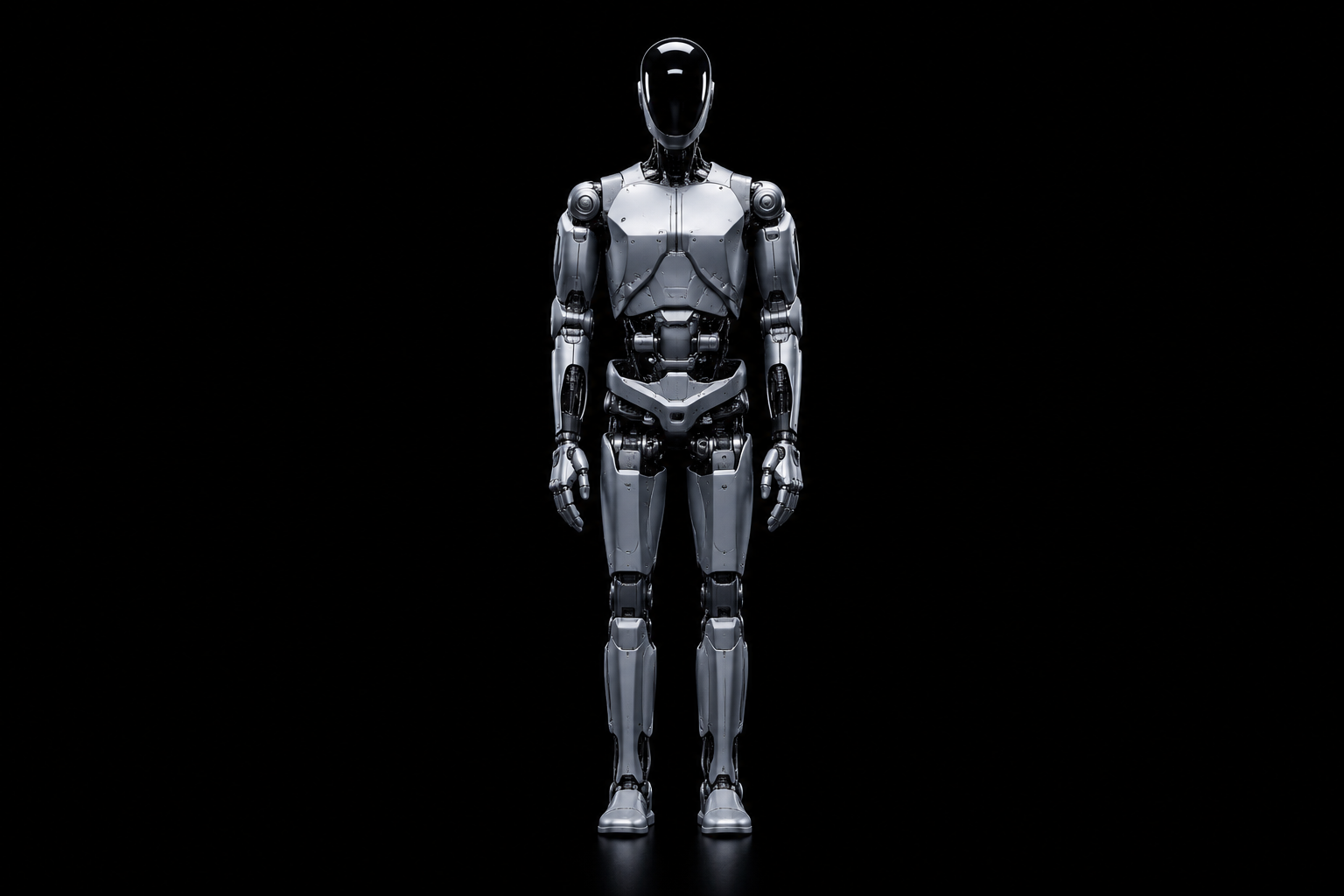
XPENG IRON
XPENG IRON is a humanoid robot by XPENG. This robot profile covers robot specs, history, AI technologies, bipedal locomotion, company background, and real-world use cases.
Description
XPENG IRON is a bionic humanoid robot developed by Chinase company XPENG Motors, featuring a human-like spine and flexible synthetic skin. This robot uses advanced artificial intelligence and solid-state batteries to perform smooth and natural movements in commercial environments. XPENG IRON's bionic spine replicates the degrees of freedom of the human vertebral column using a series of actuated vertebra-like joints, enabling upper-body motion profiles that motion-capture studies rate as significantly more natural than single-axis waist pivots on competing humanoids. XPENG Motors directly integrates its automotive ADAS AI stack derived from highway and urban autonomous driving into IRON's perception pipeline, leveraging millions of real-world driving hours of training data for environmental understanding. The flexible synthetic skin covering IRON's face and upper limbs uses a multi-layer elastomer construction optimized to minimize uncanny valley effects while providing substrate compatibility with future embedded tactile sensor arrays.
Taken together, XPENG IRON reads as a platform built around height of 178 cm, weight of 70 kg, and dof of 82, with Bionic spine, Flexible synthetic skin, and Solid-state batteries supporting Commercial environments, Customer assistance, and Technology demonstration. That makes the profile feel more grounded in how XPENG Motors China is positioning the robot for real operating environments rather than as a one-off demo.
Specifications
In practical terms, these figures describe a robot optimized for Commercial environments, Customer assistance, and Technology demonstration, while Bionic spine, Flexible synthetic skin, and Solid-state batteries define the balance between mobility, perception, and manipulation. The specification set also helps explain the scale of tasks XPENG IRON can realistically handle today.
History
- 2025: New generation XPENG IRON unveiled
- 2025: Solid-state battery integration
- 2026: Tests in commercial environments
Overall, the timeline shows how XPENG IRON moved from research or early unveiling toward clearer operational intent, with each stage tightening the link between height of 178 cm, weight of 70 kg, and dof of 82 and the jobs it is expected to perform. It also shows how the project matured from concept validation into a more deployment-oriented platform.
Use Cases
- Commercial environments
- Customer assistance
- Technology demonstration
- Bionic robotics research
Across these roles, XPENG IRON is being framed less as a general-purpose android and more as a system that can repeatedly deliver value in Commercial environments, Customer assistance, and Technology demonstration. Bionic spine, Flexible synthetic skin, and Solid-state batteries are the pieces that make those scenarios believable, because they connect sensing, planning, and physical execution into one workflow.
Technical Details
The XPENG IRON humanoid robot features high-torque electric servo actuators across 60 joints providing up to 200 degrees of freedom, with hands offering 22 DoF for precise manipulation.QVIRO, Humanoid.guide. Equipped with a 720° vision system and powered by three proprietary Turing AI chips delivering 2,250-3,000 TOPS for its Vision-Language-Action AI system, it excels in real-time perception, natural conversation, and complex physical tasks like EV assembly.Interesting Engineering, Humanoid.guide.
Taken together, this stack suggests a machine whose real advantage comes from how Bionic spine, Flexible synthetic skin, and Solid-state batteries are coordinated around height of 178 cm, weight of 70 kg, and dof of 82. The result is a platform that can convert perception into stable motion and task execution with less operator intervention than a simpler scripted robot.
Technologies dream
Authentic artificial creativity composition, improvisation and original interpretation, emotional expression through movement indistinguishable from a human artist, human-robot creative collaboration, emergence of its own artistic style.
Past
XPENG Motors transferred autonomous driving sensors, actuators, and AI from its electric vehicles to humanoid form, a growing trend in China's EV-to-robot pipeline.
Present
Bionic multi-vertebra spine, synthetic skin, automotive-grade sensors and motors, autonomous driving AI adapted for bipedal navigation.
Future
EV manufacturers becoming the dominant humanoid producers, leveraging automotive supply chains, AI, and manufacturing scale.
Technologies
- Bionic spine
- Flexible synthetic skin
- Solid-state batteries
- 82 degrees of freedom
- Advanced AI for natural movements
- Multimodal vision
Together, these technologies show that XPENG IRON depends on a layered architecture rather than one breakthrough component. Bionic spine, Flexible synthetic skin, and Solid-state batteries provide the core capabilities, while the surrounding stack determines how well the robot can perceive context, stay stable, and complete tasks without fragile scripting.