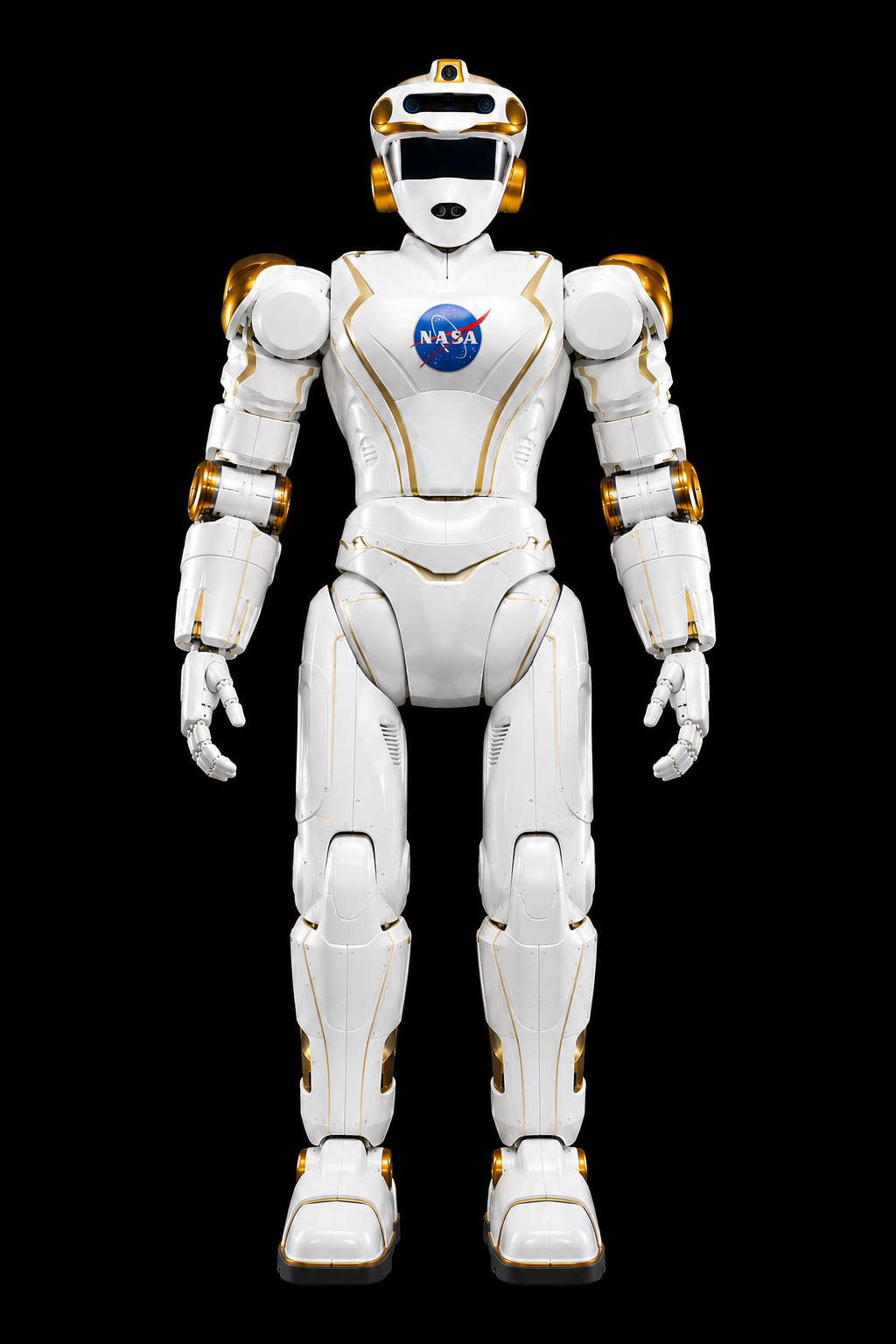
Valkyrie
Valkyrie is a humanoid robot by NASA. This robot profile covers robot specs, history, AI technologies, bipedal locomotion, company background, and real-world use cases.
Description
Valkyrie (R5) is NASA's humanoid robot, designed to operate in degraded environments and prepare space missions. Standing 188 cm and weighing 125 kg with 44 DoF, Valkyrie is developed at the Johnson Space Center. It is intended to perform maintenance and exploration tasks on the Moon and Mars before astronauts arrive. Valkyrie was designed and built in just 14 months for the 2013 DARPA Robotics Challenge, demonstrating NASA's capacity for rapid humanoid development. NASA subsequently loaned units to MIT, the University of Edinburgh, and Northeastern University, enabling distributed research on autonomous manipulation and locomotion for future Moon and Mars missions. The Carnegie Robotics Multisense SL sensor head integrates calibrated stereo cameras, spinning LiDAR, and an IMU in a single weatherized enclosure, providing robust perception in dusty or low-light extraterrestrial analog environments.
Taken together, Valkyrie reads as a platform built around height of 188 cm, weight of 125 kg, and dof of 44, with Series-elastic actuators for safety, Multi, and Locomotion on rough terrain supporting Precursor space exploration, Space station maintenance, and Lunar and Martian operations. That makes the profile feel more grounded in how NASA Johnson Space Center Houston, Texas, USA is positioning the robot for real operating environments rather than as a one-off demo.
Specifications
In practical terms, these figures describe a robot optimized for Precursor space exploration, Space station maintenance, and Lunar and Martian operations, while Series-elastic actuators for safety, Multi, and Locomotion on rough terrain define the balance between mobility, perception, and manipulation. The specification set also helps explain the scale of tasks Valkyrie can realistically handle today.
History
- 2013: Valkyrie created for the DARPA Robotics Challenge
- 2015: Two units loaned to MIT and Northeastern universities
- 2017: University collaboration program expanded
- 2023: Partnership with Apptronik for development
- 2024: Advanced locomotion and manipulation tests
- 2026: Preparation for Artemis lunar missions
Overall, the timeline shows how Valkyrie moved from research or early unveiling toward clearer operational intent, with each stage tightening the link between height of 188 cm, weight of 125 kg, and dof of 44 and the jobs it is expected to perform. It also shows how the project matured from concept validation into a more deployment-oriented platform.
Use Cases
- Precursor space exploration
- Space station maintenance
- Lunar and Martian operations
- Disaster response
- Advanced robotics research
- Infrastructure inspection
Across these roles, Valkyrie is being framed less as a general-purpose android and more as a system that can repeatedly deliver value in Precursor space exploration, Space station maintenance, and Lunar and Martian operations. Series-elastic actuators for safety, Multi, and Locomotion on rough terrain are the pieces that make those scenarios believable, because they connect sensing, planning, and physical execution into one workflow.
Technical Details
NASA's Valkyrie humanoid robot utilizes series elastic rotary and linear actuators across its 44 degrees of freedom, enabling robust operation in degraded environments.NASA fact sheet It features a Carnegie Robotics Multisense SL head sensor with stereo and LIDAR capabilities, multiple IMUs, force-torque sensors in ankles and wrists, pressure sensors in hands and feet, and is powered by Intel Core i7 processors running ROS-based decentralized torque control with whole-body control algorithms for dexterous manipulation and bipedal locomotion.UTEXAS Valkyrie paper
Taken together, this stack suggests a machine whose real advantage comes from how Series-elastic actuators for safety, Multi, and Locomotion on rough terrain are coordinated around height of 188 cm, weight of 125 kg, and dof of 44. The result is a platform that can convert perception into stable motion and task execution with less operator intervention than a simpler scripted robot.
Technologies dream
Fully autonomous operation on Mars for years, self-construction of habitats from Martian materials, autonomous repair of critical space systems, cosmic radiation resistance, satellite relay communication with Earth.
Past
NASA's robotics lineage includes Robonaut 1 (1997) and Robonaut 2 (ISS, 2011). Valkyrie was built for the DARPA Robotics Challenge in just 14 months.
Present
44 DoF, series elastic rotary + linear actuators, Carnegie Robotics Multisense SL head (stereo + LiDAR), multiple IMUs, torque-controlled compliant joints.
Future
Autonomous lunar habitat construction, Mars surface operations, deep-space maintenance without real-time human teleoperation due to communication delays.
Technologies
- Series-elastic actuators for safety
- Multi-sensor 3D perception (LiDAR + stereo)
- Locomotion on rough terrain
- Manipulation with dexterous hands
- ROS 2 for distributed control
- Adaptive autonomy in hostile environments
- Whole-body motion planning
- Long-distance space communication
Together, these technologies show that Valkyrie depends on a layered architecture rather than one breakthrough component. Series-elastic actuators for safety, Multi, and Locomotion on rough terrain provide the core capabilities, while the surrounding stack determines how well the robot can perceive context, stay stable, and complete tasks without fragile scripting.