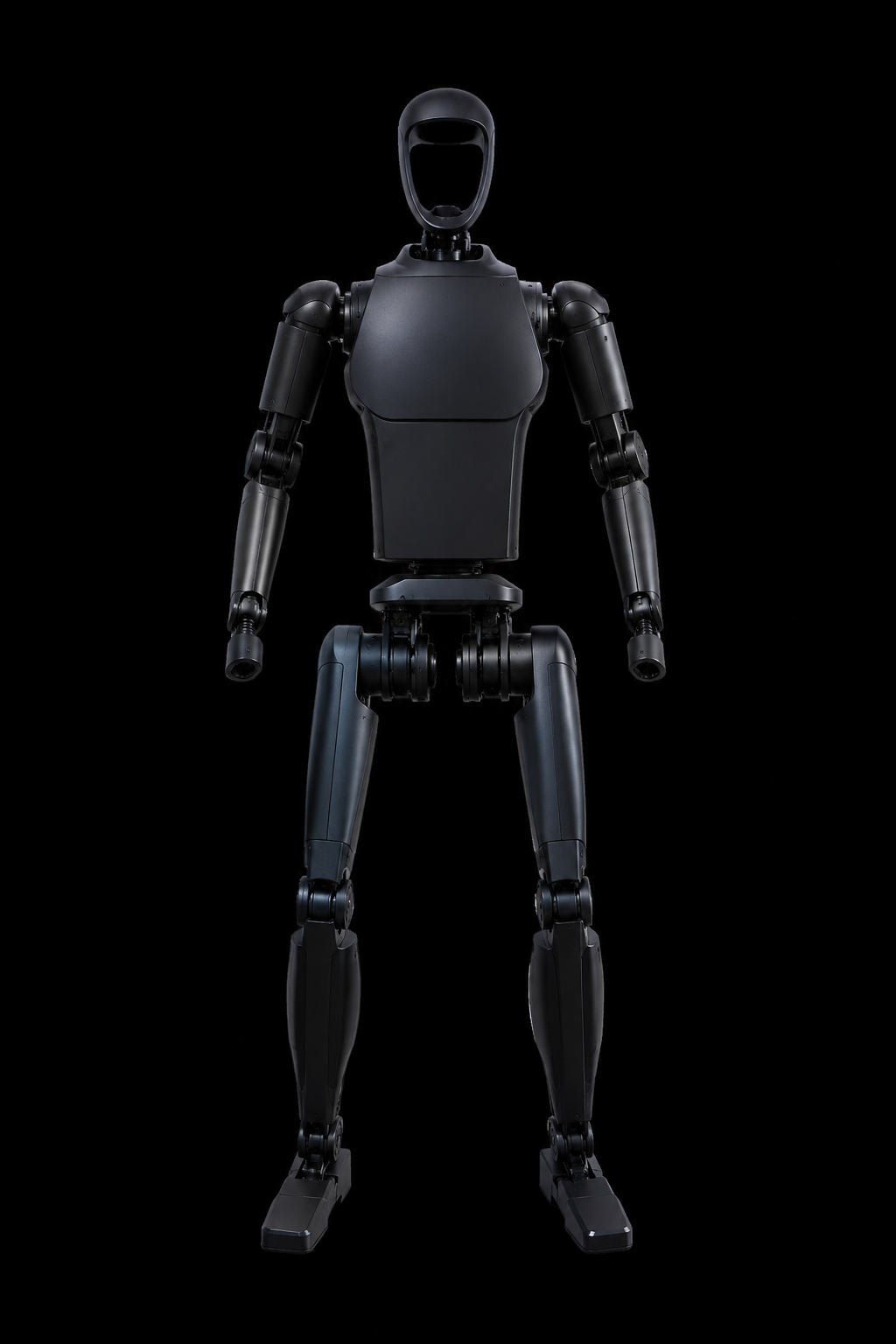
Unitree H1
Unitree H1 is a humanoid robot by Unitree Robotics. This robot profile covers robot specs, history, AI technologies, bipedal locomotion, company background, and real-world use cases.
Description
This feat was considered impossible without hydraulic actuators before Unitree demonstrated it with high-torque 360 Nm electric motors. Standing 180 cm tall and weighing only 47 kg, the H1 is remarkably lightweight. At under $90,000, it has democratized high-performance humanoid robotics research. In 2024, the H1 became the first humanoid robot to execute a standing backflip using purely electric actuators, validating its M107 PMSM motors' 360 N·m peak torque capability a feat previously considered to require hydraulic power. At the 2026 Chinese New Year Gala, a troupe of H1 units performed a precisely synchronized dance routine viewed by an estimated 700 million people, one of the largest humanoid robot public demonstrations in history. Unitree offers the H1 with an open development SDK, attracting a global research community that contributes locomotion and manipulation algorithms back to the platform.
Taken together, Unitree H1 reads as a platform built around height of 180 cm, weight of 47 kg, and battery of High-density Li-Po, with High, Locomotion reinforcement learning, and Advanced IMU for balance detection supporting Academic robotics and AI research, Reinforcement locomotion research, and Industrial inspection and monitoring. That makes the profile feel more grounded in how Unitree Robotics Hangzhou, China is positioning the robot for real operating environments rather than as a one-off demo.
Specifications
In practical terms, these figures describe a robot optimized for Academic robotics and AI research, Reinforcement locomotion research, and Industrial inspection and monitoring, while High, Locomotion reinforcement learning, and Advanced IMU for balance detection define the balance between mobility, perception, and manipulation. The specification set also helps explain the scale of tasks Unitree H1 can realistically handle today.
History
- 2023: Unitree H1 unveiled
- 2024: H1 Evolution V3.0 lateral steps and stairs
- 2024: Adopted by universities and AI labs worldwide
- 2025: H1-2 with improved manipulation
- 2026: Reference platform for locomotion research
Overall, the timeline shows how Unitree H1 moved from research or early unveiling toward clearer operational intent, with each stage tightening the link between height of 180 cm, weight of 47 kg, and battery of High-density Li-Po and the jobs it is expected to perform. It also shows how the project matured from concept validation into a more deployment-oriented platform.
Use Cases
- Academic robotics and AI research
- Reinforcement locomotion research
- Industrial inspection and monitoring
- Emergency prototype development
- Locomotion benchmark platform
- Sim-to-real transfer research
Across these roles, Unitree H1 is being framed less as a general-purpose android and more as a system that can repeatedly deliver value in Academic robotics and AI research, Reinforcement locomotion research, and Industrial inspection and monitoring. High, Locomotion reinforcement learning, and Advanced IMU for balance detection are the pieces that make those scenarios believable, because they connect sensing, planning, and physical execution into one workflow.
Technical Details
The Unitree H1 humanoid robot features high-torque electric actuators like the M107 PMSM motors delivering up to 360 N·m peak torque at the knee, Intel RealSense depth cameras and 3D LiDAR for 360° perception, an AI-powered control system with Intel Core i7 computing for balance and gait, 19 degrees of freedom (5 per leg, 4 per arm, 1 waist), and excels at world-record.Unitree,Wikipedia,ROS Components
Taken together, this stack suggests a machine whose real advantage comes from how High, Locomotion reinforcement learning, and Advanced IMU for balance detection are coordinated around height of 180 cm, weight of 47 kg, and battery of High-density Li-Po. The result is a platform that can convert perception into stable motion and task execution with less operator intervention than a simpler scripted robot.
Technologies dream
Locomotion with perfect stability on any terrain, integrated thruster-assisted flight, 360° omnidirectional perception via quantum sensor fusion, learning new skills in seconds through cloud experience transfer.
Past
Unitree pioneered affordable quadrupeds (Go1, A1) using mass-produced PMSM motors, then transferred legged locomotion expertise to bipedal humanoid form.
Present
M107 motors (360 N·m), Intel RealSense + 3D LiDAR, reinforcement learning for dynamic locomotion, first hydraulic-free backflip, synchronized multi-robot dance.
Future
General-purpose manipulation with dexterous hands, outdoor autonomous navigation, integration with Unitree's AI training platform for rapid skill acquisition.
Technologies
- High-torque electric actuators (360 Nm)
- Locomotion reinforcement learning
- Advanced IMU for balance detection
- Dynamic control with recovery
- Architecture ROS 2
- Onboard LiDAR for 3D perception
- Isaac Gym sim-to-real transfer
- Modular joint design
Together, these technologies show that Unitree H1 depends on a layered architecture rather than one breakthrough component. High, Locomotion reinforcement learning, and Advanced IMU for balance detection provide the core capabilities, while the surrounding stack determines how well the robot can perceive context, stay stable, and complete tasks without fragile scripting.