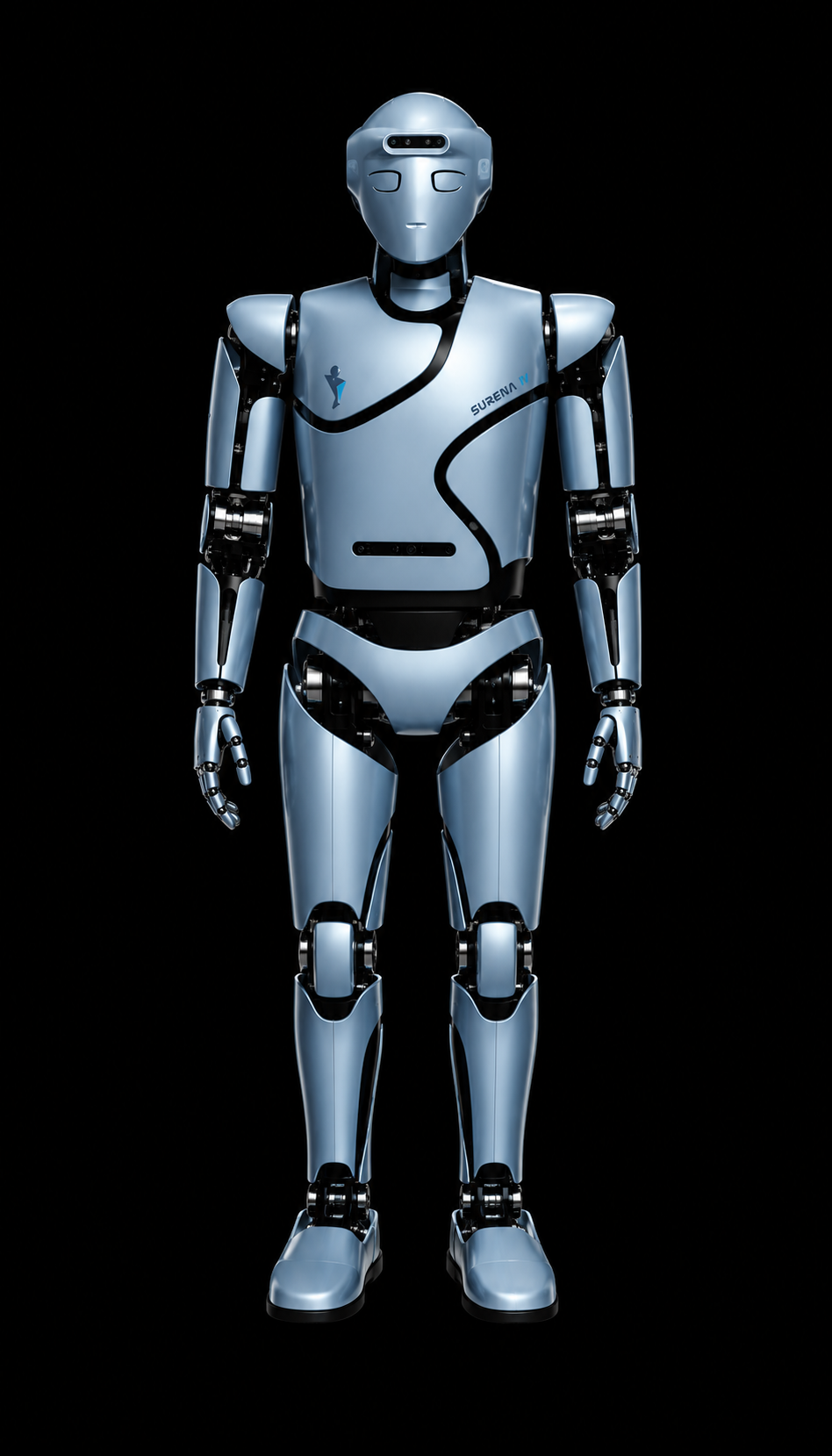
Surena IV
Surena IV is a humanoid robot by University of Tehran. This robot profile covers robot specs, history, AI technologies, bipedal locomotion, company background, and real-world use cases.
Description
Surena IV is Iran's most advanced humanoid robot, developed at the Center for Advanced Systems and Technologies (CAST) at the University of Tehran. Standing 170 cm with 43 DoF, Surena IV can walk on irregular terrain, mimic human gestures, and speak Persian. Recognized by IEEE, it represents a major advance for robotics in the Middle East. Surena IV represents a complete domestic development effort at the University of Tehran's CAST laboratory, with all mechanical components, actuators, and control electronics designed and manufactured in Iran a significant achievement under international technology access constraints. The CAST team published trajectory optimization and balance control algorithms derived from Surena IV experiments in IEEE Transactions on Robotics and other top-tier venues, demonstrating internationally competitive research output. At 170 cm and 43 DoF, Surena IV can walk on irregular surfaces, climb stairs, and perform object manipulation, serving as Iran's primary testbed for advanced humanoid locomotion and manipulation research.
Taken together, Surena IV reads as a platform built around height of 170 cm, dof of 43, and recognition of IEEE, with Dynamic locomotion on irregular terrain, 43 articular degrees of freedom, and Real-time human gesture imitation supporting Academic robotics research, Locomotion on irregular terrain, and Human gesture imitation. That makes the profile feel more grounded in how University of Tehran Tehran, Iran is positioning the robot for real operating environments rather than as a one-off demo.
Specifications
In practical terms, these figures describe a robot optimized for Academic robotics research, Locomotion on irregular terrain, and Human gesture imitation, while Dynamic locomotion on irregular terrain, 43 articular degrees of freedom, and Real-time human gesture imitation define the balance between mobility, perception, and manipulation. The specification set also helps explain the scale of tasks Surena IV can realistically handle today.
History
- 2008: Surena I Iran's first humanoid
- 2010: Surena II with improved locomotion
- 2015: Surena III significant progress
- 2019: Surena IV unveiled 43 DoF, irregular terrain
- 2020: Recognition by IEEE
- 2024: Ongoing research at the University of Tehran
Overall, the timeline shows how Surena IV moved from research or early unveiling toward clearer operational intent, with each stage tightening the link between height of 170 cm, dof of 43, and recognition of IEEE and the jobs it is expected to perform. It also shows how the project matured from concept validation into a more deployment-oriented platform.
Use Cases
- Academic robotics research
- Locomotion on irregular terrain
- Human gesture imitation
- Communication in Persian
- National technology demonstration
- Engineering education and training
Across these roles, Surena IV is being framed less as a general-purpose android and more as a system that can repeatedly deliver value in Academic robotics research, Locomotion on irregular terrain, and Human gesture imitation. Dynamic locomotion on irregular terrain, 43 articular degrees of freedom, and Real-time human gesture imitation are the pieces that make those scenarios believable, because they connect sensing, planning, and physical execution into one workflow.
Technical Details
The Surena IV humanoid robot from the University of Tehran features 43 degrees of freedom, custom actuators including 21 harmonic drive and high-torque motors plus servos, and sensors such as cameras, IMU, 6-axis force-torque sensors, encoders, and microphones ROBOTS Guide, CAST. Its AI system enables face/object detection, speech recognition/synthesis, and action imitation, with a key capability of on uneven terrain using predictive foot sensors and force-controlled grasping IEEE.
Taken together, this stack suggests a machine whose real advantage comes from how Dynamic locomotion on irregular terrain, 43 articular degrees of freedom, and Real-time human gesture imitation are coordinated around height of 170 cm, dof of 43, and recognition of IEEE. The result is a platform that can convert perception into stable motion and task execution with less operator intervention than a simpler scripted robot.
Technologies dream
Universal research platform with human-level embodied AI, one-demonstration skill learning, instant knowledge transfer between robots, algorithmic self-evolution, total situational awareness.
Past
The University of Tehran's CAST lab built Surena I-III over 10 years, progressively advancing Iran's indigenous humanoid robotics capability.
Present
43 DoF, online walking pattern generation, multi-modal perception, 5-fingered grasping, face recognition, inclined surface walking.
Future
Iran's humanoid technology contributing to international robotics research, cross-border collaboration on embodied AI challenges.
Technologies
- Dynamic locomotion on irregular terrain
- 43 articular degrees of freedom
- Real-time human gesture imitation
- Persian speech recognition and synthesis
- Stereo vision for environmental perception
- Foot force/torque sensors
- Adaptive gait planning
- Stabilization by torque control
Together, these technologies show that Surena IV depends on a layered architecture rather than one breakthrough component. Dynamic locomotion on irregular terrain, 43 articular degrees of freedom, and Real-time human gesture imitation provide the core capabilities, while the surrounding stack determines how well the robot can perceive context, stay stable, and complete tasks without fragile scripting.