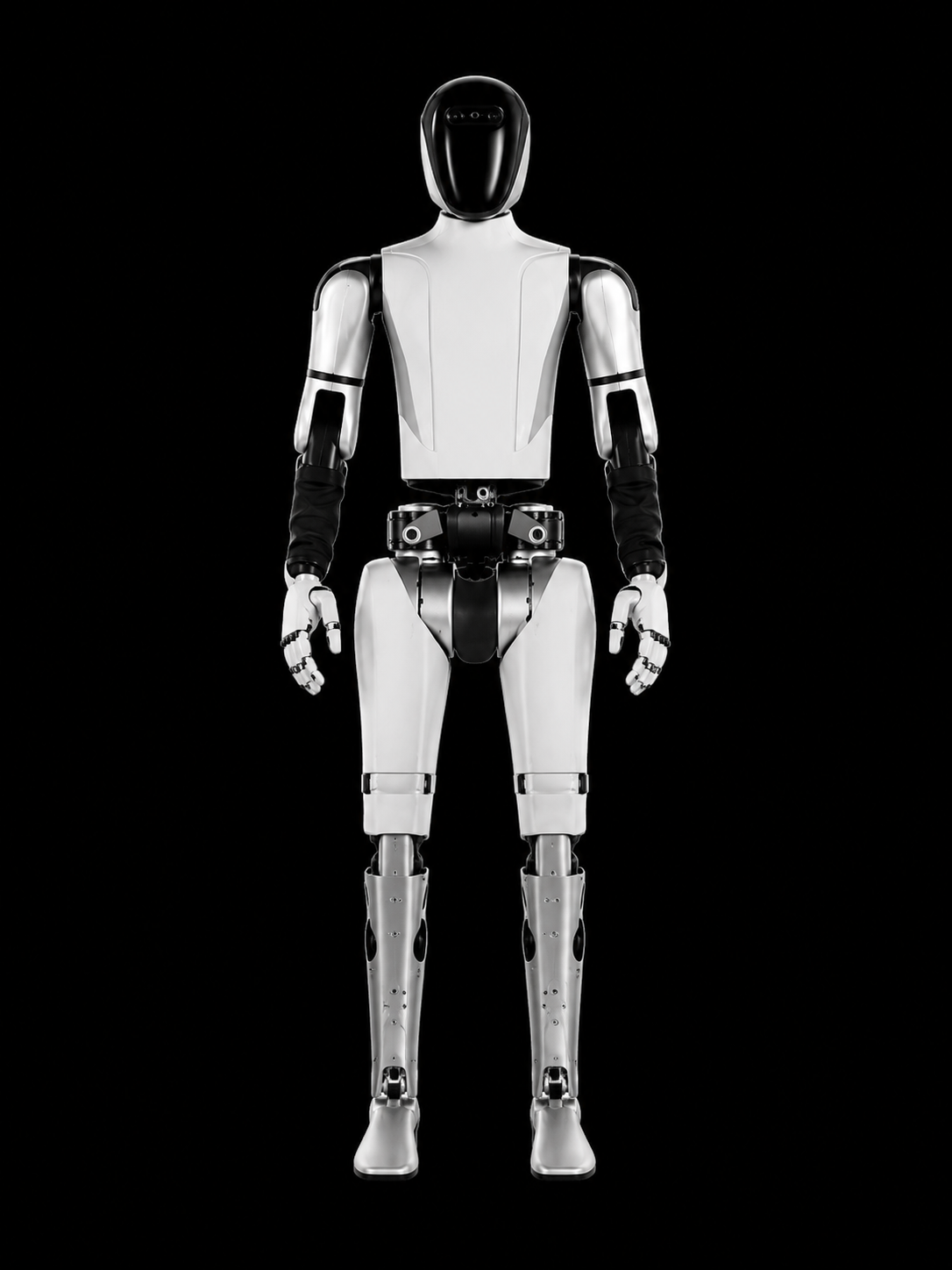
STAR1
STAR1 is a humanoid robot by Robot Era. This robot profile covers robot specs, history, AI technologies, bipedal locomotion, company background, and real-world use cases.
Description
The STAR1 is a cutting-edge humanoid robot developed by Chinese company Robot Era. It integrates advanced artificial intelligence and high-torque motors to navigate autonomously across varied terrains such as the Gobi Desert. Robot Era's highly parallelized GPU reinforcement learning pipeline using domain randomization in simulation enables STAR1 to acquire new locomotion skills from approximately 30 minutes of simulated training and deploy them to physical hardware the same day, dramatically compressing the simulation-to-real development cycle. The STAR1's high-torque joint modules were designed for high peak current output to sustain running gaits that demand instantaneous power several times higher than walking.
Taken together, STAR1 reads as a platform built around ai of Advanced, with High-speed bipedal locomotion, Navigation on varied terrains, and Control artificial intelligence supporting Fast locomotion research, Navigation on varied terrains, and Service applications. That makes the profile feel more grounded in how Robot Era (Beijing Xingdong Era Technology) Beijing, China is positioning the robot for real operating environments rather than as a one-off demo.
Specifications
In practical terms, these figures describe a robot optimized for Fast locomotion research, Navigation on varied terrains, and Service applications, while High-speed bipedal locomotion, Navigation on varied terrains, and Control artificial intelligence define the balance between mobility, perception, and manipulation. The specification set also helps explain the scale of tasks STAR1 can realistically handle today.
History
- 2024: STAR1 launched by Robot Era
- 2024: Test in the Gobi Desert
Overall, the timeline shows how STAR1 moved from research or early unveiling toward clearer operational intent, with each stage tightening the link between ai of Advanced and the jobs it is expected to perform. It also shows how the project matured from concept validation into a more deployment-oriented platform.
Use Cases
- Fast locomotion research
- Navigation on varied terrains
- Service applications
- Robotics competitions
Across these roles, STAR1 is being framed less as a general-purpose android and more as a system that can repeatedly deliver value in Fast locomotion research, Navigation on varied terrains, and Service applications. High-speed bipedal locomotion, Navigation on varied terrains, and Control artificial intelligence are the pieces that make those scenarios believable, because they connect sensing, planning, and physical execution into one workflow.
Technical Details
The RobotEra STAR1 humanoid robot features direct-drive actuators delivering up to 400 Nm joint torque and 25 rad/s peak speeds, with 55 degrees of freedom including 12 DOF legs, 3 DOF waist, and 12 DOF XHAND1 dexterous hands.Humanoid.guide It integrates the ERA-42 end-to-end AI system for mastering over 100 precision tasks and employs advanced sensors enabling a dynamic locomotion across challenging terrains, alongside precise manipulation capabilities.Humanoid.guide
Taken together, this stack suggests a machine whose real advantage comes from how High-speed bipedal locomotion, Navigation on varied terrains, and Control artificial intelligence are coordinated around ai of Advanced. The result is a platform that can convert perception into stable motion and task execution with less operator intervention than a simpler scripted robot.
Technologies dream
Authentic artificial creativity composition, improvisation and original interpretation, emotional expression through movement indistinguishable from a human artist, human-robot creative collaboration, emergence of its own artistic style.
Past
Robot Era combined Chinese motor manufacturing expertise with reinforcement learning research to create a humanoid optimized for dynamic locomotion.
Present
55 DoF, direct-drive actuators (400 Nm), 12-DoF XHAND1 hands, ERA-42 end-to-end AI system, autonomous terrain navigation.
Future
Industrial deployment for logistics and inspection, outdoor autonomous operation in urban environments, multi-robot warehouse coordination.
Technologies
- High-speed bipedal locomotion
- Navigation on varied terrains
- Control artificial intelligence
- Manual dexterity (chopsticks)
Together, these technologies show that STAR1 depends on a layered architecture rather than one breakthrough component. High-speed bipedal locomotion, Navigation on varied terrains, and Control artificial intelligence provide the core capabilities, while the surrounding stack determines how well the robot can perceive context, stay stable, and complete tasks without fragile scripting.