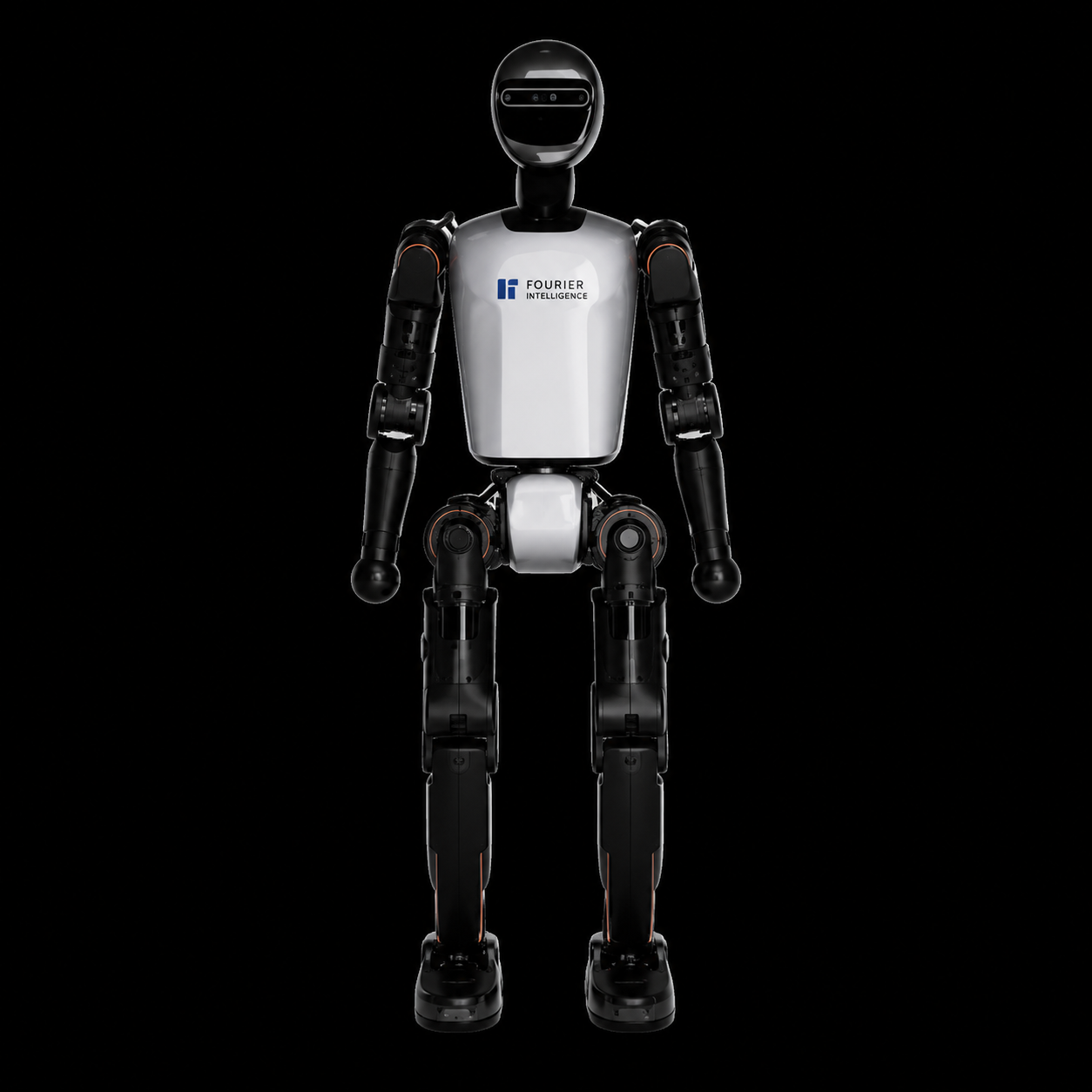
Orca 1
Orca 1 is a humanoid robot by Cyan Robotics. This robot profile covers robot specs, history, AI technologies, bipedal locomotion, company background, and real-world use cases.
Description
The Orca 1 is an innovative bipedal humanoid robot designed by Cyan Robotics for research and service applications. It stands out for its straight-knee human-like gait and its ability to express emotions via an OLED screen integrated into its head. Sources: Humanoid.guide, Mike Kalil, TEAMS Design Orca 1's straight-knee gait is achieved through a patented joint geometry that transfers stance-phase ground reaction forces through near-vertical limb alignment, reducing knee actuator power demand by approximately 25% compared to conventional bent-knee humanoid designs. Cyan Robotics markets Orca 1 below $15,000, targeting university research groups and robotics curriculum programs at academic budget levels. The robot's LED face display supports 16 programmable emotion states controlled via the same API as the motion controller, enabling researchers to study the effect of expressive robot behavior on human interaction quality.
Taken together, Orca 1 reads as a platform built around application of Service / Research, with Human-like straight-knee gait, Integrated OLED screen for emotions, and Advanced bipedal locomotion supporting Robotics research, Service applications, and Emotional expression. That makes the profile feel more grounded in how Cyan Robotics China is positioning the robot for real operating environments rather than as a one-off demo.
Specifications
In practical terms, these figures describe a robot optimized for Robotics research, Service applications, and Emotional expression, while Human-like straight-knee gait, Integrated OLED screen for emotions, and Advanced bipedal locomotion define the balance between mobility, perception, and manipulation. The specification set also helps explain the scale of tasks Orca 1 can realistically handle today.
History
- 2024: Orca 1 unveiled by Cyan Robotics
- 2025: Straight-knee gait demonstration
Overall, the timeline shows how Orca 1 moved from research or early unveiling toward clearer operational intent, with each stage tightening the link between application of Service / Research and the jobs it is expected to perform. It also shows how the project matured from concept validation into a more deployment-oriented platform.
Use Cases
- Robotics research
- Service applications
- Emotional expression
- Experimental platform
Across these roles, Orca 1 is being framed less as a general-purpose android and more as a system that can repeatedly deliver value in Robotics research, Service applications, and Emotional expression. Human-like straight-knee gait, Integrated OLED screen for emotions, and Advanced bipedal locomotion are the pieces that make those scenarios believable, because they connect sensing, planning, and physical execution into one workflow.
Technical Details
The Orca 1 humanoid robot from Cyan Robotics utilizes ORCA Series smart linear actuators (or electric servo motors with harmonic/planetary reducers) and features 40 degrees of freedom, including 10 in each hand. It is equipped with depth cameras, IMUs, force/torque sensors, and microphone arrays, powered by a real-time AI system with the macr language model enabling sub-millisecond latency control and natural interaction, with a key capability of completing a half-marathon while performing straight-knee walking and dynamic maneuvers like stair climbing and spinning Aparobot, Humanoid.guide, Shanghai.gov.
Taken together, this stack suggests a machine whose real advantage comes from how Human-like straight-knee gait, Integrated OLED screen for emotions, and Advanced bipedal locomotion are coordinated around application of Service / Research. The result is a platform that can convert perception into stable motion and task execution with less operator intervention than a simpler scripted robot.
Technologies dream
Deep emotional awareness with authentic empathy, conversation indistinguishable from a human, instant cultural and linguistic adaptation, long-term relational memory, contextual understanding of social nuances.
Past
Cyan Robotics developed biomechanically accurate straight-knee walking, solving one of the hardest problems in bipedal locomotion energy-efficient natural gait.
Present
Natural straight-knee gait, human-like walking biomechanics, energy-efficient locomotion, research + commercial service platform.
Future
Robots that walk so naturally they are indistinguishable from humans at a distance, enabling seamless integration into public spaces.
Technologies
- Human-like straight-knee gait
- Integrated OLED screen for emotions
- Advanced bipedal locomotion
- Innovative expressive design
Together, these technologies show that Orca 1 depends on a layered architecture rather than one breakthrough component. Human-like straight-knee gait, Integrated OLED screen for emotions, and Advanced bipedal locomotion provide the core capabilities, while the surrounding stack determines how well the robot can perceive context, stay stable, and complete tasks without fragile scripting.