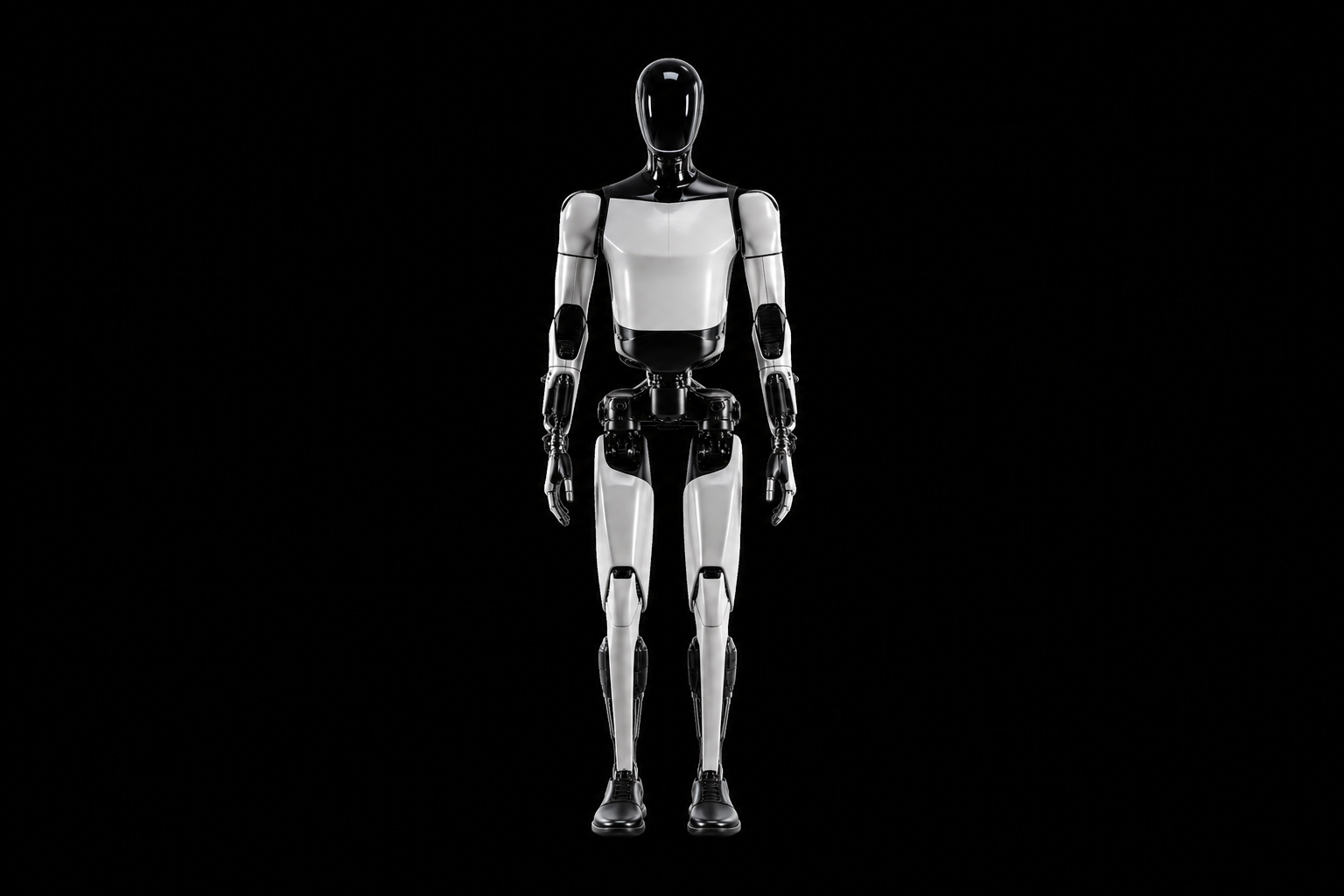
Optimus
Optimus is a humanoid robot by Tesla. This robot profile covers robot specs, history, AI technologies, bipedal locomotion, company background, and real-world use cases.
Description
Optimus (formerly Tesla Bot) is Tesla's versatile humanoid robot, leveraging the company's massive AI infrastructure. Unveiled by Elon Musk in October 2022, Optimus represents the vision of a robot capable of performing any repetitive, dangerous, or tedious task. By 2025, multiple units were already working autonomously in Tesla factories, with external sales planned from 2026. By early 2025 Tesla had deployed over 1,000 Optimus units in its Fremont factory for battery cell sorting, cable routing, and parts retrieval the largest humanoid robot fleet of any manufacturer at that time. Tesla's unique advantage is its ability to leverage camera data from millions of on-road vehicles to generate diverse manipulation training datasets at unprecedented scale. Gen 3 introduced improved tactile feedback in the fingertips, allowing Optimus to handle objects as fragile as an egg without damage.
Taken together, Optimus reads as a platform built around height of 1,73 m, weight of 57 kg, and payload of 20 kg, with Adapted Tesla FSD neural network, Dojo supercomputer for AI training, and Human imitation learning supporting Material handling and sorting in Tesla factories, Warehouse logistics, and Repetitive manufacturing tasks. That makes the profile feel more grounded in how Tesla, Inc. Austin, Texas, USA is positioning the robot for real operating environments rather than as a one-off demo.
Specifications
In practical terms, these figures describe a robot optimized for Material handling and sorting in Tesla factories, Warehouse logistics, and Repetitive manufacturing tasks, while Adapted Tesla FSD neural network, Dojo supercomputer for AI training, and Human imitation learning define the balance between mobility, perception, and manipulation. The specification set also helps explain the scale of tasks Optimus can realistically handle today.
History
- August 2021: Tesla Bot concept announced at AI Day
- October 2022: First Optimus prototype walks on stage
- December 2023: Optimus Gen 2 30% faster, 10 kg lighter
- March 2024: Optimus performs autonomous tasks at Tesla Fremont
- 2025: Multiple units deployed in Tesla factories
- 2026: External sales announced, thousands of units per year targeted
Overall, the timeline shows how Optimus moved from research or early unveiling toward clearer operational intent, with each stage tightening the link between height of 1,73 m, weight of 57 kg, and payload of 20 kg and the jobs it is expected to perform. It also shows how the project matured from concept validation into a more deployment-oriented platform.
Use Cases
- Material handling and sorting in Tesla factories
- Warehouse logistics
- Repetitive manufacturing tasks
- Household chores (long-term vision)
- Elderly assistance
- Operations in hazardous environments
Across these roles, Optimus is being framed less as a general-purpose android and more as a system that can repeatedly deliver value in Material handling and sorting in Tesla factories, Warehouse logistics, and Repetitive manufacturing tasks. Adapted Tesla FSD neural network, Dojo supercomputer for AI training, and Human imitation learning are the pieces that make those scenarios believable, because they connect sensing, planning, and physical execution into one workflow.
Technical Details
Tesla Optimus employs custom linear actuators with planetary roller screw technology and rotary actuators across its 28 structural joints for precise motion. Equipped with 8 high-resolution cameras, IMU, force/torque sensors, and Tesla's Full Self-Driving AI system running on custom inference hardware, it offers 22 degrees of freedom per hand (Gen 3) enabling key capabilities like 20 kg payload carrying.
Taken together, this stack suggests a machine whose real advantage comes from how Adapted Tesla FSD neural network, Dojo supercomputer for AI training, and Human imitation learning are coordinated around height of 1,73 m, weight of 57 kg, and payload of 20 kg. The result is a platform that can convert perception into stable motion and task execution with less operator intervention than a simpler scripted robot.
Technologies dream
Mass production at 10 million units/year, complete domestic awareness via foundation models, one-shot learning of any human task, distributed neural network across all Optimus units worldwide, kinetic energy harvesting for perpetual autonomy.
Past
Tesla's initial prototype (2021) was a human in a suit. Gen 1 (2022) used off-the-shelf actuators. Gen 2 added custom planetary roller screws and 11-DoF hands.
Present
28 structural joints, custom linear/rotary actuators, Tesla FSD-derived neural networks for vision, end-to-end learned manipulation from teleoperation data.
Future
Mass production at under $20,000, household autonomy via foundation models, Optimus as Tesla's core revenue driver according to Musk's long-term vision.
Technologies
- Adapted Tesla FSD neural network
- Dojo supercomputer for AI training
- Human imitation learning
- Multimodal visual sensors (8 cameras)
- Custom rotary and linear actuators
- End-to-end neural control
- Natural language understanding
- Autonomous trajectory planning
Together, these technologies show that Optimus depends on a layered architecture rather than one breakthrough component. Adapted Tesla FSD neural network, Dojo supercomputer for AI training, and Human imitation learning provide the core capabilities, while the surrounding stack determines how well the robot can perceive context, stay stable, and complete tasks without fragile scripting.