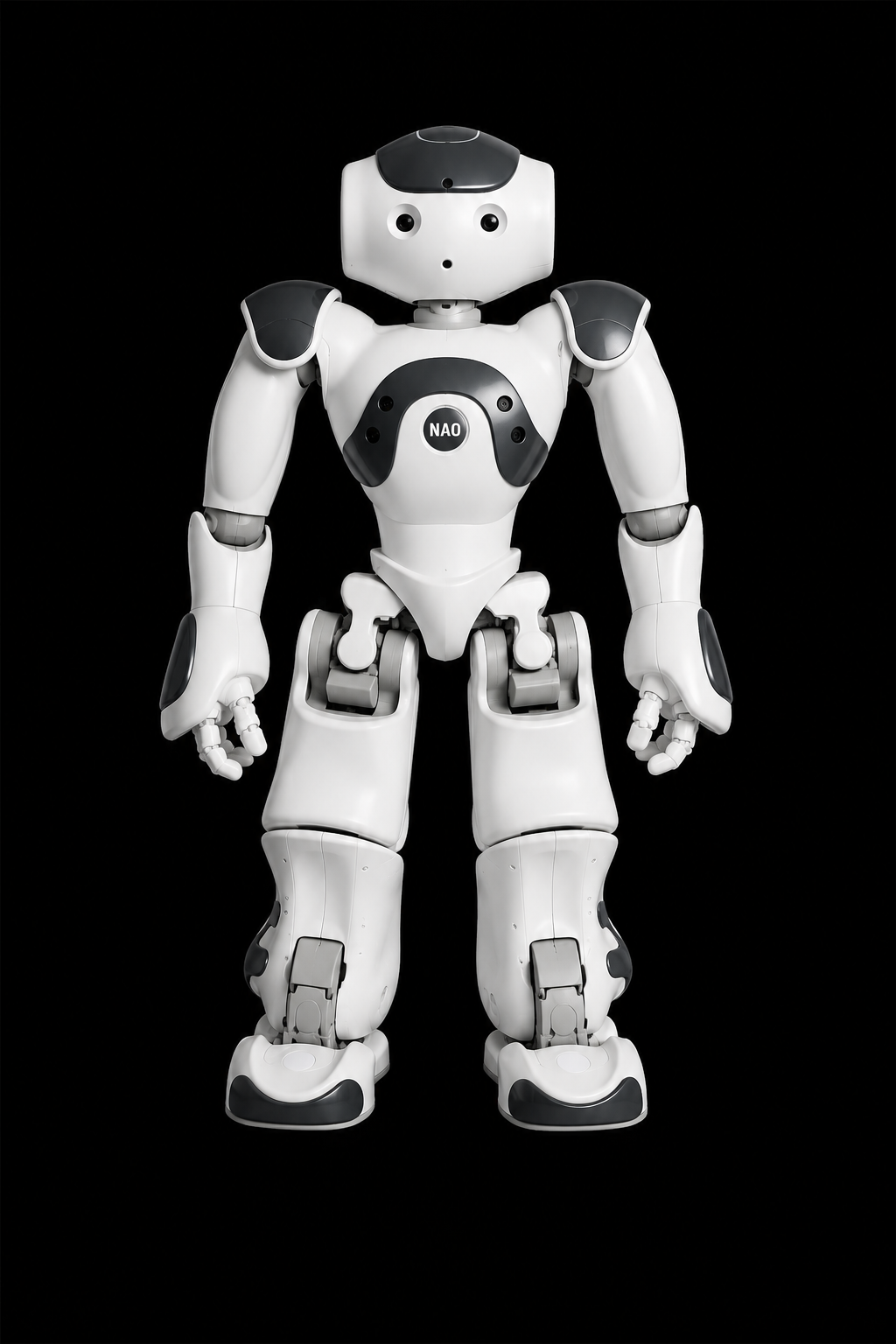
NAO
NAO is a humanoid robot by Aldebaran. This robot profile covers robot specs, history, AI technologies, bipedal locomotion, company background, and real-world use cases.
Description
NAO is one of the most iconic and widely adopted humanoid robots in history. This 58 cm programmable robot, developed by Aldebaran Robotics in Paris, is used by more than 5,000 institutions in 50+ countries since 2008. NAO replaced the Sony AIBO as the official RoboCup robot and trained an entire generation of robotics researchers. With 25 DoF, it remains the reference standard in educational robotics. More than 13,000 NAO units have been deployed across universities, research labs, and schools in over 70 countries, making it the most widely distributed humanoid research robot in history. Since 2008, NAO has been the exclusive platform for the RoboCup Standard Platform League, where teams from over 40 nations compete annually by writing fully autonomous soccer AI creating one of the largest open-source humanoid software ecosystems globally. SoftBank Robotics developed dedicated IDEs (Choregraphe and Python SDK) that lowered the barrier to humanoid programming for non-specialist researchers and students.
Taken together, NAO reads as a platform built around height of 58 cm, weight of 5,4 kg, and dof of 25, with Choregraphe visual programming SDK, Python, C++ and Java API, and Voice recognition and multilingual synthesis supporting University robotics education, RoboCup Standard Platform League competition, and Autism therapy and social skills. That makes the profile feel more grounded in how Aldebaran Robotics Paris, France is positioning the robot for real operating environments rather than as a one-off demo.
Specifications
In practical terms, these figures describe a robot optimized for University robotics education, RoboCup Standard Platform League competition, and Autism therapy and social skills, while Choregraphe visual programming SDK, Python, C++ and Java API, and Voice recognition and multilingual synthesis define the balance between mobility, perception, and manipulation. The specification set also helps explain the scale of tasks NAO can realistically handle today.
History
- 2004: Aldebaran Robotics founded by Bruno Maisonnier
- 2006: NAO prototype demonstrated
- 2008: NAO V3 commercialized replaces AIBO at RoboCup
- 2012: SoftBank acquires Aldebaran Robotics
- 2018: NAO V6 with improved cameras and processing
- 2023: Aldebaran re-established as an independent brand
Overall, the timeline shows how NAO moved from research or early unveiling toward clearer operational intent, with each stage tightening the link between height of 58 cm, weight of 5,4 kg, and dof of 25 and the jobs it is expected to perform. It also shows how the project matured from concept validation into a more deployment-oriented platform.
Use Cases
- University robotics education (5,000+ institutions)
- RoboCup Standard Platform League competition
- Autism therapy and social skills
- K-12 STEM education
- Human-robot interaction research
- Reception and welcome (limited deployments)
Across these roles, NAO is being framed less as a general-purpose android and more as a system that can repeatedly deliver value in University robotics education, RoboCup Standard Platform League competition, and Autism therapy and social skills. Choregraphe visual programming SDK, Python, C++ and Java API, and Voice recognition and multilingual synthesis are the pieces that make those scenarios believable, because they connect sensing, planning, and physical execution into one workflow.
Technologies dream
Evolving educational companion that grows with the child over decades, autonomous curriculum design, emotional intelligence coaching, peer-level social interaction for children with autism, self-updating knowledge base.
Past
Aldebaran created NAO (2008) as an affordable, programmable humanoid, replacing Sony's AIBO as the RoboCup standard and democratizing robotics education.
Present
58 cm, 25 DoF, used in 5,000+ institutions across 70+ countries, RoboCup platform, autism therapy, STEM education.
Future
NAO's legacy: an entire generation of roboticists trained on this platform, now building the next generation of humanoid robots.
Technologies
- Choregraphe visual programming SDK
- Python, C++ and Java API
- Voice recognition and multilingual synthesis
- Facial detection and recognition (100 faces)
- Ultrasonic sonar for obstacle avoidance
- RESTful API for cloud/web integration
- NAOqi operating system
- Integrated accelerometer and gyroscope
Together, these technologies show that NAO depends on a layered architecture rather than one breakthrough component. Choregraphe visual programming SDK, Python, C++ and Java API, and Voice recognition and multilingual synthesis provide the core capabilities, while the surrounding stack determines how well the robot can perceive context, stay stable, and complete tasks without fragile scripting.