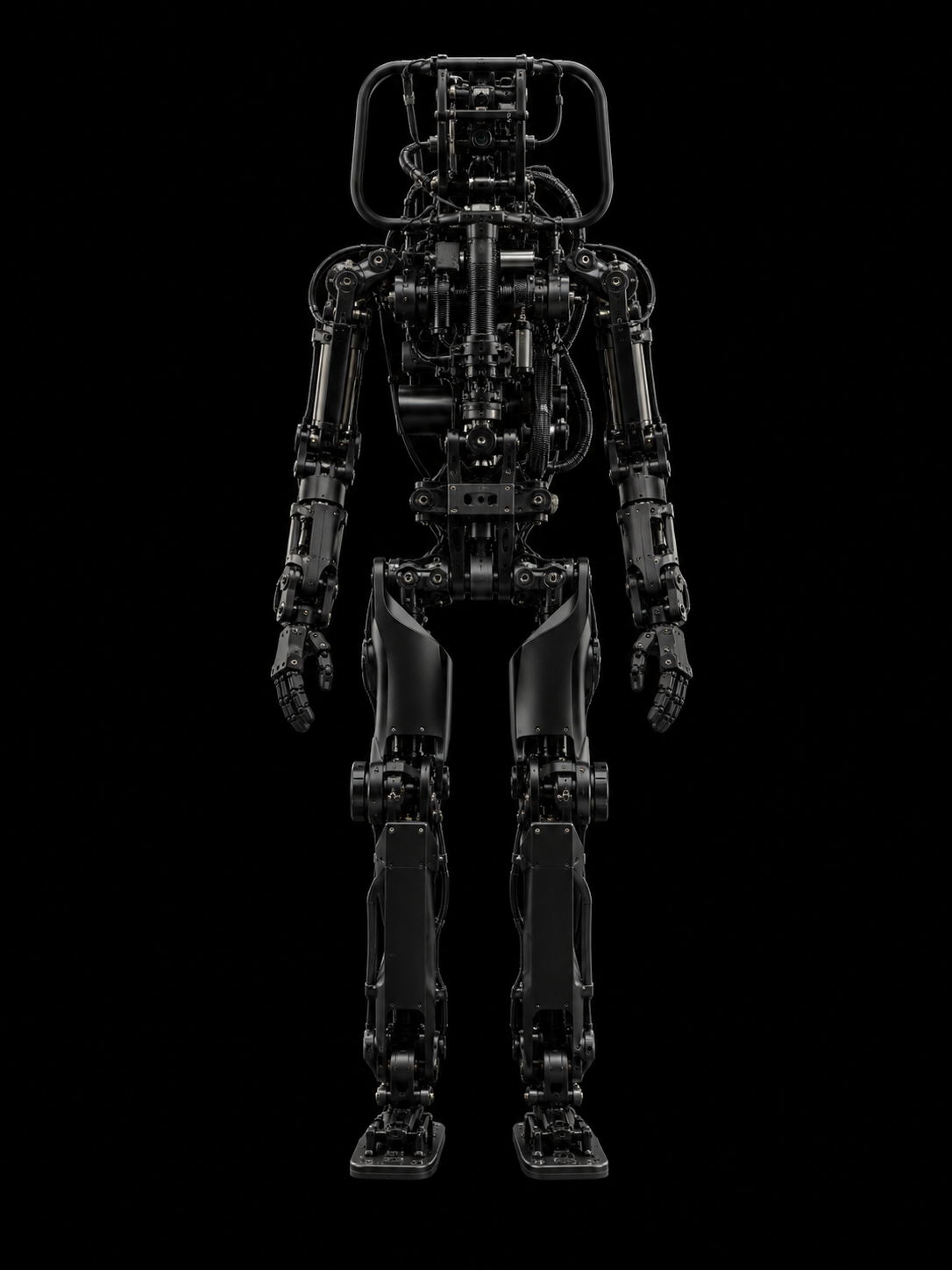
HRP-5P
HRP-5P is a humanoid robot by AIST. This robot profile covers robot specs, history, AI technologies, bipedal locomotion, company background, and real-world use cases.
Description
The HRP-5P is a cutting-edge humanoid robot developed by AIST in Japan, capable of autonomously performing heavy construction work. It stands 182 cm tall and has 37 degrees of freedom, enabling it to handle plasterboard panels and use power tools. HRP-5P was developed by AIST to address labor shortages in Japan's construction industry by automating physically demanding tasks such as drywall installation, plywood boarding, and drilling. In a landmark demonstration, HRP-5P autonomously installed gypsum board panels on a real construction site without human intervention the first time a bipedal humanoid completed a full construction task cycle in an unstructured environment. Its 37-DoF design includes a high-payload waist joint rated for 75 kg object handling, wrist force/torque sensors, and whole-body contact detection.
Taken together, HRP-5P reads as a platform built around height of 182 cm, dof of 37, and application of Construction, with 37 degrees of freedom, Construction panel manipulation, and Autonomous power tool use supporting Autonomous construction, Plasterboard handling, and Power tool use. That makes the profile feel more grounded in how AIST Tsukuba, Japon is positioning the robot for real operating environments rather than as a one-off demo.
Specifications
In practical terms, these figures describe a robot optimized for Autonomous construction, Plasterboard handling, and Power tool use, while 37 degrees of freedom, Construction panel manipulation, and Autonomous power tool use define the balance between mobility, perception, and manipulation. The specification set also helps explain the scale of tasks HRP-5P can realistically handle today.
History
- 2018: HRP-5P unveiled by AIST
- 2018: Plasterboard installation demonstration
- 2019: Autonomous construction tests
Overall, the timeline shows how HRP-5P moved from research or early unveiling toward clearer operational intent, with each stage tightening the link between height of 182 cm, dof of 37, and application of Construction and the jobs it is expected to perform. It also shows how the project matured from concept validation into a more deployment-oriented platform.
Use Cases
- Autonomous construction
- Plasterboard handling
- Power tool use
- Heavy construction work
Across these roles, HRP-5P is being framed less as a general-purpose android and more as a system that can repeatedly deliver value in Autonomous construction, Plasterboard handling, and Power tool use. 37 degrees of freedom, Construction panel manipulation, and Autonomous power tool use are the pieces that make those scenarios believable, because they connect sensing, planning, and physical execution into one workflow.
Technical Details
The HRP-5P humanoid robot features electrically actuated high-torque motors with drive cooling and multi-motor joints, 37 degrees of freedom (neck: 2 DoF, waist: 3 DoF, arms: 8 DoF each, legs: 6 DoF each, hands: 2 DoF each), stereo vision, LiDAR, 3D sensors, and palm cameras for object recognition.AISTRobots Guide Its custom AI system enables full-body motion planning, task execution management, and autonomous handling of heavy objects up to 13 kg, such as gypsum boards in construction environments.AISTRobots Guide
Taken together, this stack suggests a machine whose real advantage comes from how 37 degrees of freedom, Construction panel manipulation, and Autonomous power tool use are coordinated around height of 182 cm, dof of 37, and application of Construction. The result is a platform that can convert perception into stable motion and task execution with less operator intervention than a simpler scripted robot.
Technologies dream
Brain-machine interface for intuitive control, real-time component self-repair, total situational awareness via neurosensory fusion, universal instant learning, 72-hour energy autonomy, swarm coordination via collective AI.
Past
AIST's HRP series (HRP-1 through HRP-4C) spent 20 years advancing humanoid capability from basic walking to autonomous construction tasks.
Present
182 cm, 101 kg, autonomous drywall installation, environmental recognition, full-body motion planning, real construction site operation.
Future
Autonomous building construction where humanoids frame walls, install fixtures, and perform finishing work without human supervision.
Technologies
- 37 degrees of freedom
- Construction panel manipulation
- Autonomous power tool use
- Motion planning for construction tasks
Together, these technologies show that HRP-5P depends on a layered architecture rather than one breakthrough component. 37 degrees of freedom, Construction panel manipulation, and Autonomous power tool use provide the core capabilities, while the surrounding stack determines how well the robot can perceive context, stay stable, and complete tasks without fragile scripting.