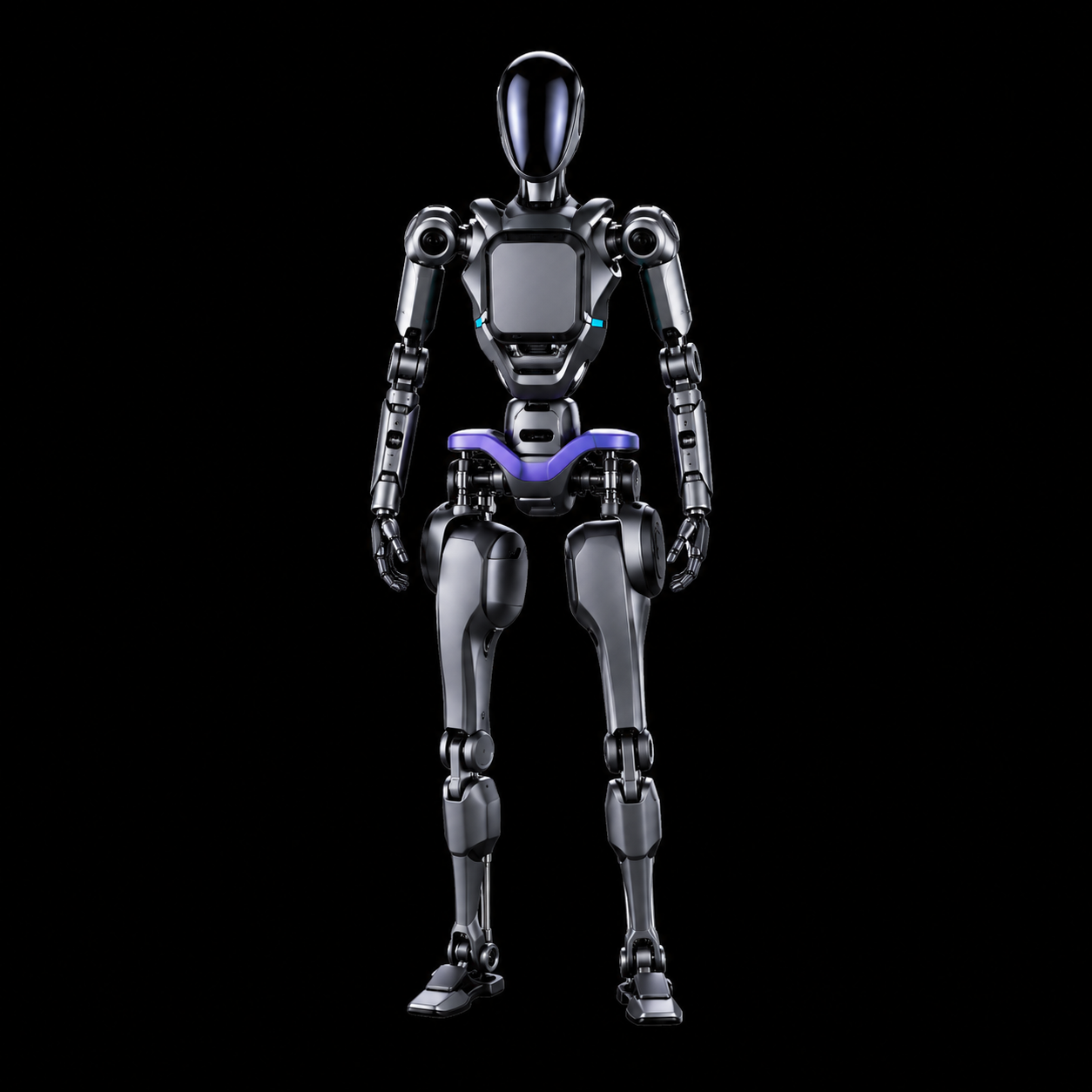
Fourier GR-1
Fourier GR-1 is a humanoid robot by Fourier Intelligence. This robot profile covers robot specs, history, AI technologies, bipedal locomotion, company background, and real-world use cases.
Description
The Fourier GR-1 is recognized as the world's first mass-produced general-purpose humanoid robot. Built by Fourier Intelligence, a company originally specialized in rehabilitation exoskeletons, the GR-1 stands 165 cm, weighs 55 kg, and has 44 joints. It uses pure-vision perception with BEV (Bird's Eye View) and 3D occupancy networks, an approach similar to Tesla's FSD. The Fourier GR-1 is widely recognized as the first general-purpose humanoid robot to achieve genuine mass production, with over 100 units shipped to research institutions, automotive companies, and AI labs in 2024. Fourier Intelligence leveraged its manufacturing infrastructure from producing more than 10,000 rehabilitation exoskeletons, applying precision actuator assembly and quality-control processes directly to GR-1 production a unique industrial advantage over pure-play robotics startups. The GR-1's 40 DoF include force-controlled joints at the ankle and wrist, enabling compliant contact interaction and making it a preferred platform for imitation learning research.
Taken together, Fourier GR-1 reads as a platform built around height of 165 cm, weight of 55 kg, and payload of 50 kg, with Proprietary Smart Actuator modules, Pure-vision BEV perception, and 3D occupancy network supporting Physical rehabilitation and therapy, Elderly assistance, and Industrial inspection and quality control. That makes the profile feel more grounded in how Fourier Intelligence Shanghai, China is positioning the robot for real operating environments rather than as a one-off demo.
Specifications
In practical terms, these figures describe a robot optimized for Physical rehabilitation and therapy, Elderly assistance, and Industrial inspection and quality control, while Proprietary Smart Actuator modules, Pure-vision BEV perception, and 3D occupancy network define the balance between mobility, perception, and manipulation. The specification set also helps explain the scale of tasks Fourier GR-1 can realistically handle today.
History
- 2015: Fourier Intelligence founded in Shanghai (exoskeletons)
- 2020: General-purpose humanoid development begins
- July 2023: GR-1 unveiled first mass-produced humanoid
- Late 2023: First GR-1 units delivered to research institutions
- 2024: GR-2 announced with major improvements
- 2025: GR-1 deployed in dozens of institutions
Overall, the timeline shows how Fourier GR-1 moved from research or early unveiling toward clearer operational intent, with each stage tightening the link between height of 165 cm, weight of 55 kg, and payload of 50 kg and the jobs it is expected to perform. It also shows how the project matured from concept validation into a more deployment-oriented platform.
Use Cases
- Physical rehabilitation and therapy
- Elderly assistance
- Industrial inspection and quality control
- Embodied AI research platform
- Logistics automation
- Healthcare facility support
Across these roles, Fourier GR-1 is being framed less as a general-purpose android and more as a system that can repeatedly deliver value in Physical rehabilitation and therapy, Elderly assistance, and Industrial inspection and quality control. Proprietary Smart Actuator modules, Pure-vision BEV perception, and 3D occupancy network are the pieces that make those scenarios believable, because they connect sensing, planning, and physical execution into one workflow.
Technical Details
The Fourier GR-1 humanoid robot features Fourier Smart Actuators (FSA) integrating motor, driver, reducer, and encoder, providing 44 degrees of freedom and peak joint torque of 230 N.m.FOURIER-Robotics, Fourier Docs. Equipped with RealSense depth cameras, ring-shaped microphone array, IMU sensors, and powered by a large language model (LLM) with i7-13700H computing, it enables key capabilities like precise manipulation with 6 DoF dexterous hands.Humanoid.guide, The Robot Report.
Taken together, this stack suggests a machine whose real advantage comes from how Proprietary Smart Actuator modules, Pure-vision BEV perception, and 3D occupancy network are coordinated around height of 165 cm, weight of 55 kg, and payload of 50 kg. The result is a platform that can convert perception into stable motion and task execution with less operator intervention than a simpler scripted robot.
Technologies dream
Autonomous rehabilitation therapy with real-time patient adaptation, early neurological disease detection via movement analysis, integrated exoskeleton for human strength amplification, assisted muscular regeneration.
Past
Fourier Intelligence built rehabilitation exoskeletons for 8 years, mastering compliant actuators and human-safe joint control before entering humanoid robotics.
Present
FSA actuators (motor+driver+reducer+encoder integrated), 44 DoF, 230 N·m peak torque, RealSense depth cameras, ring microphone array, IMU sensors.
Future
Mass deployment in elderly care facilities, AI-driven rehabilitation assistance, learning personalized movement patterns for each patient.
Technologies
- Proprietary Smart Actuator modules
- Pure-vision BEV perception
- 3D occupancy network
- Force control for rehabilitation
- Motor control technology adapted from exoskeletons
- Patient gesture and movement detection
- Cloud platform for model updates
- Compliance control for safe interaction
Together, these technologies show that Fourier GR-1 depends on a layered architecture rather than one breakthrough component. Proprietary Smart Actuator modules, Pure-vision BEV perception, and 3D occupancy network provide the core capabilities, while the surrounding stack determines how well the robot can perceive context, stay stable, and complete tasks without fragile scripting.