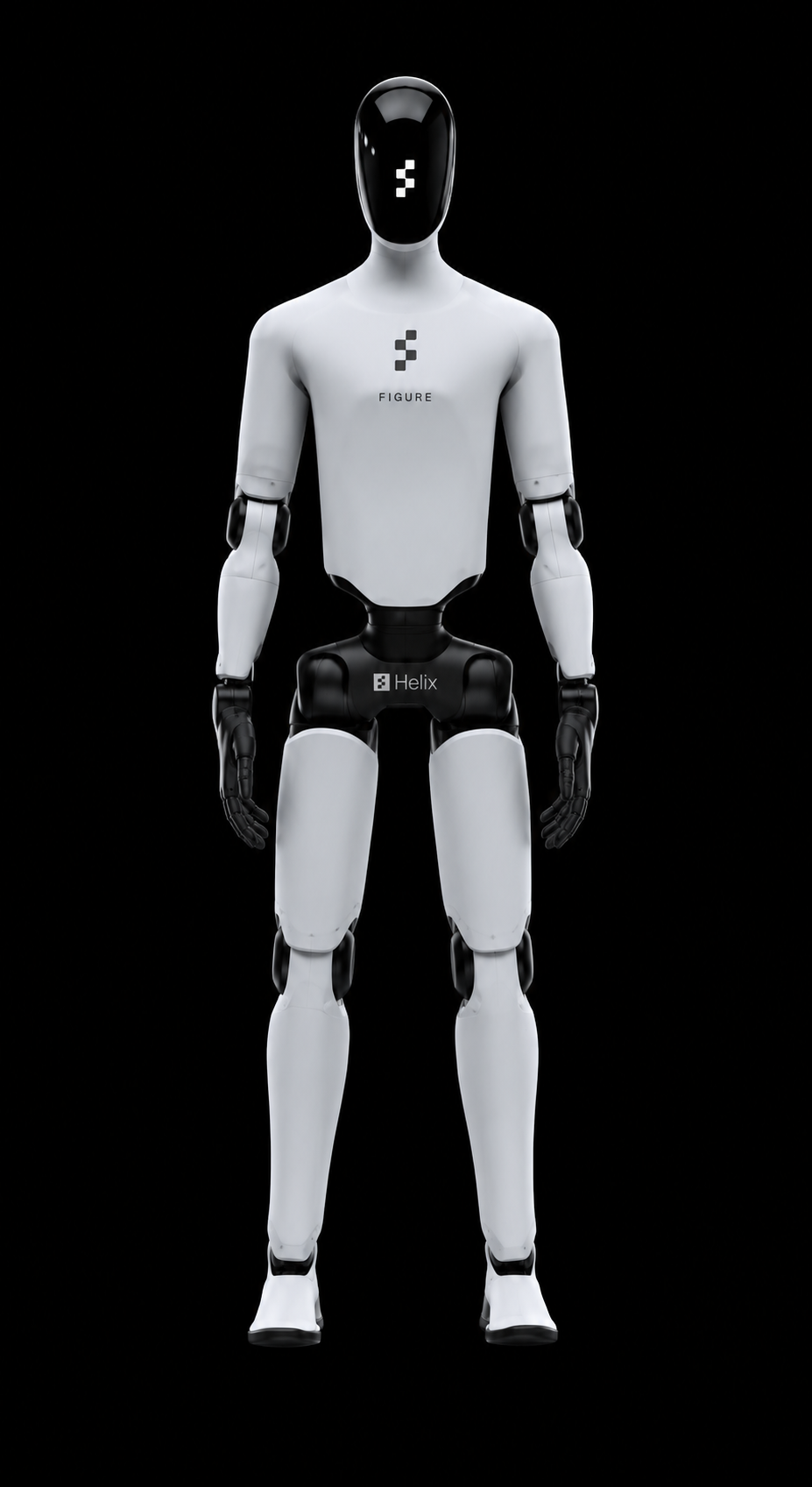
Figure 03
Figure 03 is a humanoid robot by Figure AI. This robot profile covers robot specs, history, AI technologies, bipedal locomotion, company background, and real-world use cases.
Description
Figure 03 is a third-generation humanoid robot designed for domestic and industrial tasks, using Helix AI to learn directly from humans. It stands out for its safety-oriented design with soft materials and mass production capability. Figure 03 features fingertip force sensors with a sensitivity threshold of approximately 3 grams, enabling manipulation of objects as fragile as glass displays and flexible circuit boards. The Helix AI model supports continuous learning from human teleoperation demonstrations, reducing the number of examples needed to generalize to new tasks. Safety was a primary design priority: the robot's exterior uses compliant soft materials and all joints are torque-limited to prevent injury during unintended human contact.
Taken together, Figure 03 reads as a platform built around ai of Helix, with Helix AI for human learning, Safe design with soft materials, and Mass production capability supporting Household tasks, Industrial applications, and Direct learning from humans. That makes the profile feel more grounded in how Figure AI Sunnyvale, Californie, USA is positioning the robot for real operating environments rather than as a one-off demo.
Specifications
In practical terms, these figures describe a robot optimized for Household tasks, Industrial applications, and Direct learning from humans, while Helix AI for human learning, Safe design with soft materials, and Mass production capability define the balance between mobility, perception, and manipulation. The specification set also helps explain the scale of tasks Figure 03 can realistically handle today.
History
- 2025: Figure (F.03) unveiled
- 2025: Helix AI integration
- 2026: Mass production planned
Overall, the timeline shows how Figure 03 moved from research or early unveiling toward clearer operational intent, with each stage tightening the link between ai of Helix and the jobs it is expected to perform. It also shows how the project matured from concept validation into a more deployment-oriented platform.
Use Cases
- Household tasks
- Industrial applications
- Direct learning from humans
- Daily assistance
Across these roles, Figure 03 is being framed less as a general-purpose android and more as a system that can repeatedly deliver value in Household tasks, Industrial applications, and Direct learning from humans. Helix AI for human learning, Safe design with soft materials, and Mass production capability are the pieces that make those scenarios believable, because they connect sensing, planning, and physical execution into one workflow.
Technical Details
The Figure humanoid robot features custom electromechanical actuators with improved torque density, a sensory suite including six RGB cameras with 60% wider field of view, palm cameras, and fingertip tactile sensors detecting forces as low as 3 grams.Figure AI announcement, Figure.ai/figure, Humanoid Press. It employs the proprietary Helix vision-language-action AI model and offers 30 degrees of freedom, enabling key capabilities such as 20kg payload lifting and
Taken together, this stack suggests a machine whose real advantage comes from how Helix AI for human learning, Safe design with soft materials, and Mass production capability are coordinated around ai of Helix. The result is a platform that can convert perception into stable motion and task execution with less operator intervention than a simpler scripted robot.
Technologies dream
Universal instant learning mastery of any task from a single observation, onboard cognition rivaling human intelligence, bionic hands with cell-level tactile sensitivity, 72-hour autonomy without recharging, authentic emotional dialogue.
Past
Figure 01 (2023) proved basic bipedal locomotion. Figure 02 added onboard AI and speech. OpenAI partnership enabled vision-language reasoning for manipulation.
Present
Helix VLA model for voice commands, 6 RGB cameras with 60% wider FOV, 3-gram fingertip tactile sensors, safety-first soft materials, BMW factory deployment.
Future
Household autonomy for cooking and cleaning, multi-robot coordination in factories, learning new tasks from a single human demonstration.
Technologies
- Helix AI for human learning
- Safe design with soft materials
- Mass production capability
- Advanced dexterous manipulation
Together, these technologies show that Figure 03 depends on a layered architecture rather than one breakthrough component. Helix AI for human learning, Safe design with soft materials, and Mass production capability provide the core capabilities, while the surrounding stack determines how well the robot can perceive context, stay stable, and complete tasks without fragile scripting.