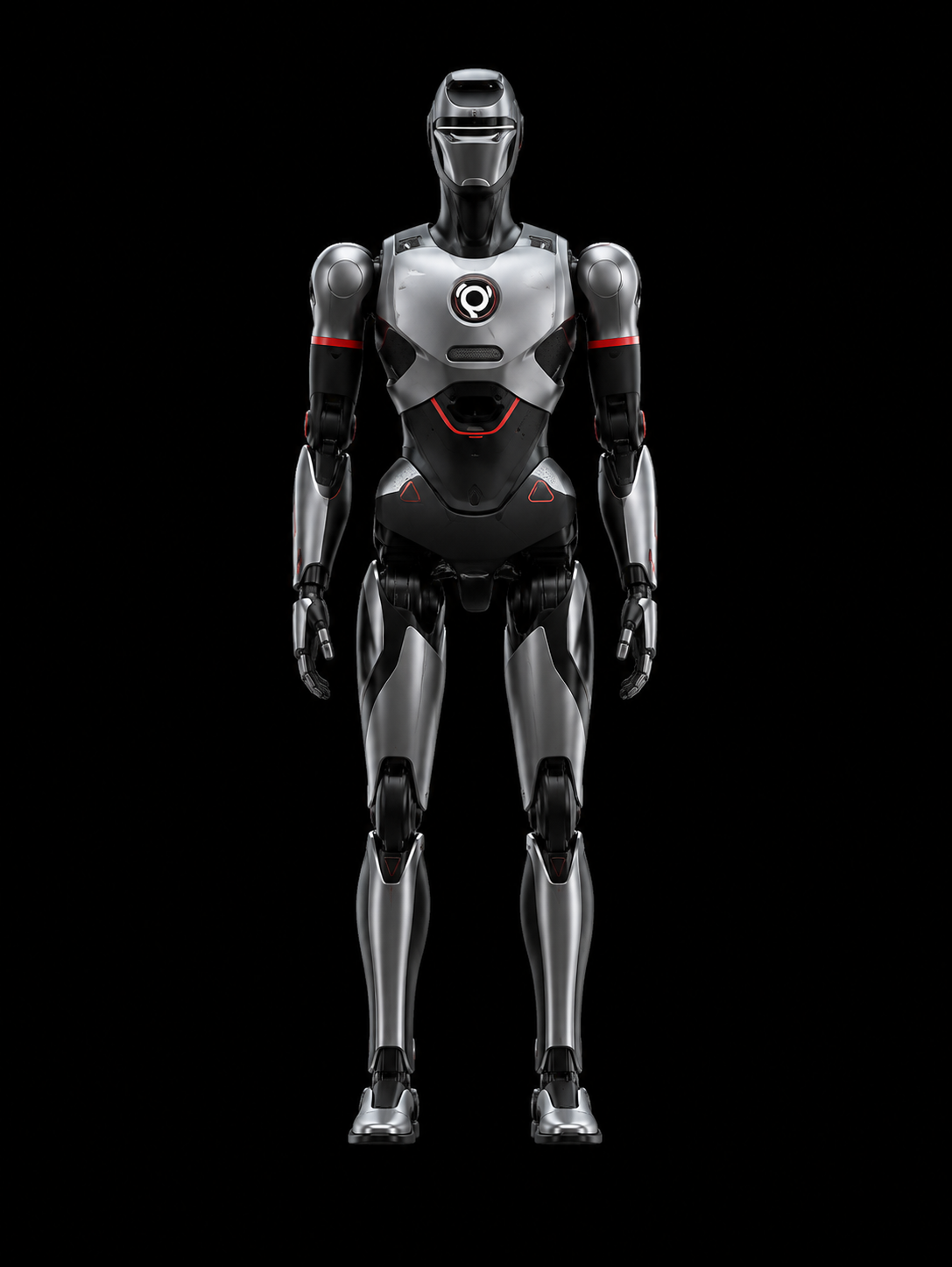
EngineAI SE01
EngineAI SE01 is a humanoid robot by EngineAI. This robot profile covers robot specs, history, AI technologies, bipedal locomotion, company background, and real-world use cases.
Description
The EngineAI SE01 is a versatile humanoid robot designed to reproduce a natural human gait through an end-to-end neural network. Made of aerospace-grade aluminum alloy, it combines lightness and robustness for interventions in industrial and domestic environments. The SE01's gait is generated by an end-to-end neural network trained on motion-captured human walking data, producing a heel-strike gait pattern perceptually indistinguishable from human walking in observer studies a technical distinction from the trajectory-planned gaits common on most commercial humanoids. Its structural frame uses 7075 aerospace-grade aluminum alloy throughout, achieving a 20% weight reduction compared to steel designs while maintaining the stiffness required for accurate end-effector positioning during manipulation. The SE01 integrates a 4D imaging radar alongside standard RGB-D cameras, providing robust object detection and tracking in low-light warehouses and outdoor environments.
Taken together, EngineAI SE01 reads as a platform built around height of 170 cm, weight of 55 kg, and dof of 32, with End-to-end neural network for walking, Aerospace-grade aluminum alloy, and Proprietary actuators supporting Industrial interventions, Home assistance, and Bipedal locomotion research. That makes the profile feel more grounded in how EngineAI Robotics Shenzhen, China is positioning the robot for real operating environments rather than as a one-off demo.
Specifications
In practical terms, these figures describe a robot optimized for Industrial interventions, Home assistance, and Bipedal locomotion research, while End-to-end neural network for walking, Aerospace-grade aluminum alloy, and Proprietary actuators define the balance between mobility, perception, and manipulation. The specification set also helps explain the scale of tasks EngineAI SE01 can realistically handle today.
History
- 2024: EngineAI SE01 launched
- 2024: Natural walking demonstration via neural network
- 2025: Deployment in pilot environments
Overall, the timeline shows how EngineAI SE01 moved from research or early unveiling toward clearer operational intent, with each stage tightening the link between height of 170 cm, weight of 55 kg, and dof of 32 and the jobs it is expected to perform. It also shows how the project matured from concept validation into a more deployment-oriented platform.
Use Cases
- Industrial interventions
- Home assistance
- Bipedal locomotion research
- Indoor delivery
Across these roles, EngineAI SE01 is being framed less as a general-purpose android and more as a system that can repeatedly deliver value in Industrial interventions, Home assistance, and Bipedal locomotion research. End-to-end neural network for walking, Aerospace-grade aluminum alloy, and Proprietary actuators are the pieces that make those scenarios believable, because they connect sensing, planning, and physical execution into one workflow.
Technical Details
The EngineAI SE01 humanoid robot features self-developed harmonic joint modules as actuators, enabling 32 degrees of freedom and up to 330 Nm maximum joint torque for complex motions like squatting and push-ups. It integrates an end-to-end neural network AI system powered by dual NVIDIA and Intel processors, Intel RealSense D435 depth cameras, 360-degree LiDAR, and six HD cameras for multi-sensor fusion and adaptive navigation as a key capability.Humanoid.guide, Aparobot, Wikipedia
Taken together, this stack suggests a machine whose real advantage comes from how End-to-end neural network for walking, Aerospace-grade aluminum alloy, and Proprietary actuators are coordinated around height of 170 cm, weight of 55 kg, and dof of 32. The result is a platform that can convert perception into stable motion and task execution with less operator intervention than a simpler scripted robot.
Technologies dream
Multi-year autonomous deep-space operation, self-construction of extraterrestrial habitats, total cosmic radiation resistance, autonomous space system repair, asteroid mining, autonomous interplanetary communication.
Past
EngineAI developed end-to-end neural network gait controllers trained entirely in simulation, eliminating the need for hand-tuned walking parameters.
Present
Neural network gait generation, human-like arm swing + heel-toe walking, sim-to-real transfer, indoor crowd navigation.
Future
Robots that walk indistinguishably from humans in any environment, adaptive gait for carrying loads or navigating obstacles.
Technologies
- End-to-end neural network for walking
- Aerospace-grade aluminum alloy
- Proprietary actuators
- Computer vision
- Advanced locomotion control
Together, these technologies show that EngineAI SE01 depends on a layered architecture rather than one breakthrough component. End-to-end neural network for walking, Aerospace-grade aluminum alloy, and Proprietary actuators provide the core capabilities, while the surrounding stack determines how well the robot can perceive context, stay stable, and complete tasks without fragile scripting.