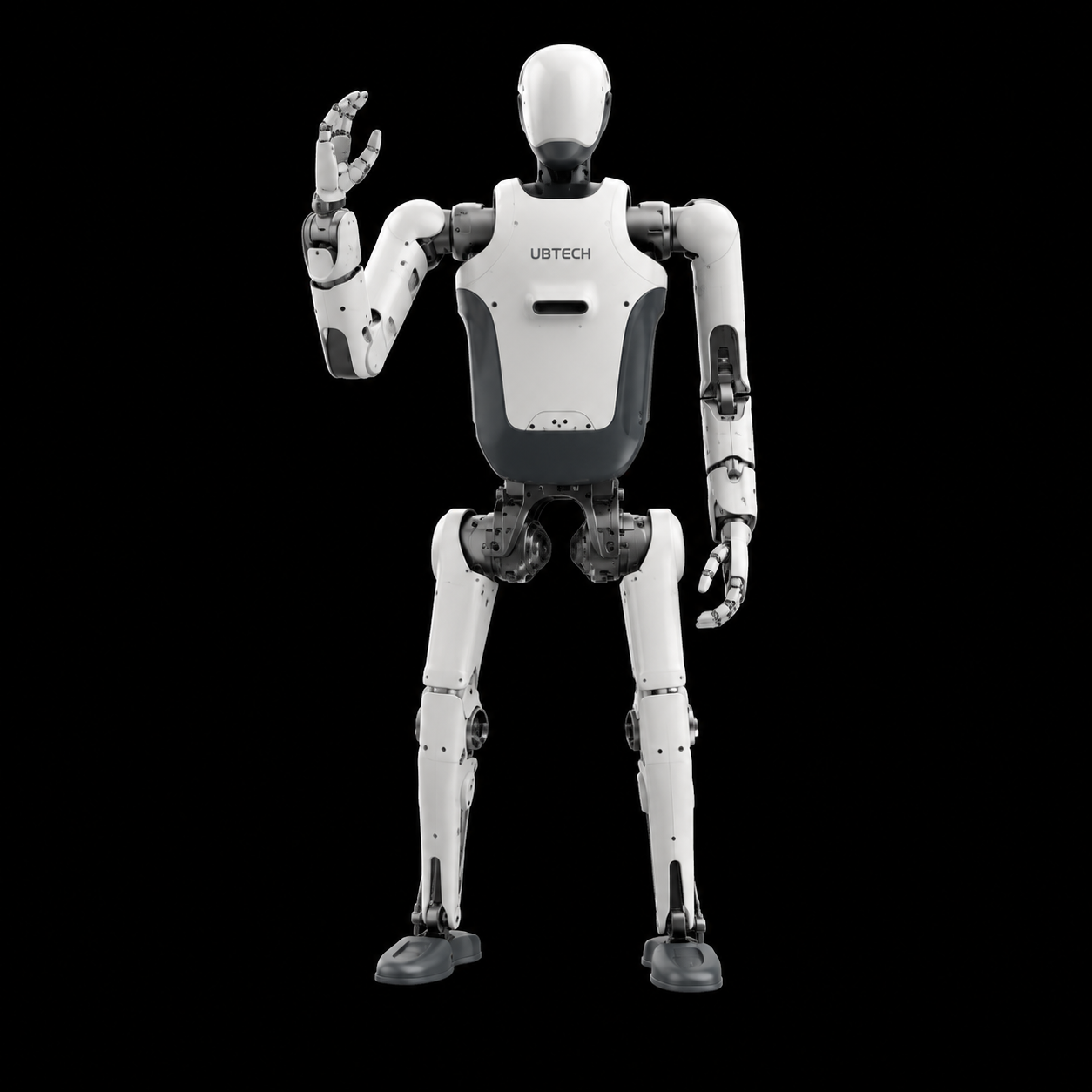
DR01
DR01 is a humanoid robot by Dimensionality Robotics. This robot profile covers robot specs, history, AI technologies, bipedal locomotion, company background, and real-world use cases.
Description
The DR01 is a bionic humanoid robot designed for embodied intelligence, capable of navigating rough terrain and stairs. It uses lightweight and powerful proprietary joints to maintain balance in the face of external disturbances. The DR01's joint modules integrate the actuator, driver electronics, and encoder in a single compact unit, eliminating the external cable harnesses that add weight and failure points on conventional humanoid designs contributing to its sub-65 kg total mass. Stair navigation combines 3D LIDAR-based geometric mapping with reinforcement-learned footstep placement policies, enabling traversal of previously unseen staircases at walking speed without operator intervention. DR01's bionic joint geometry closely mirrors human anatomical joint axes, enabling motion capture data from human performers to be directly retargeted to the robot accelerating the creation of natural-looking manipulation demonstrations.
Taken together, DR01 reads as a platform built around a specification profile tuned to its intended workload, with Lightweight and powerful proprietary joints, Navigation on rough terrain, and Dynamic balance against perturbations supporting Embodied intelligence, Navigation on complex terrain, and Industrial applications. That makes the profile feel more grounded in how DEEP Robotics Hangzhou, China is positioning the robot for real operating environments rather than as a one-off demo.
Specifications
In practical terms, these figures describe a robot optimized for Embodied intelligence, Navigation on complex terrain, and Industrial applications, while Lightweight and powerful proprietary joints, Navigation on rough terrain, and Dynamic balance against perturbations define the balance between mobility, perception, and manipulation. The specification set also helps explain the scale of tasks DR01 can realistically handle today.
History
- 2024: DR01 unveiled at the World Robot Conference
- 2024: Rough terrain navigation demonstration
Overall, the timeline shows how DR01 moved from research or early unveiling toward clearer operational intent, with each stage tightening the link between a specification profile tuned to its intended workload and the jobs it is expected to perform. It also shows how the project matured from concept validation into a more deployment-oriented platform.
Use Cases
- Embodied intelligence
- Navigation on complex terrain
- Industrial applications
- Locomotion research
Across these roles, DR01 is being framed less as a general-purpose android and more as a system that can repeatedly deliver value in Embodied intelligence, Navigation on complex terrain, and Industrial applications. Lightweight and powerful proprietary joints, Navigation on rough terrain, and Dynamic balance against perturbations are the pieces that make those scenarios believable, because they connect sensing, planning, and physical execution into one workflow.
Technical Details
The DR01 humanoid robot from DEEP Robotics features self-developed J60 lightweight joints and J100 high-torque joints as actuators, fusion perception sensors integrating self and environmental data, and an AI system enabling autonomous learning through big data training for new behavioral skills. It offers 12 degrees of freedom and a key capability of while navigating 18 cm steps and 25° slopes with balance recovery under disturbances.Deep Robotics official, Humanoid.guide
Taken together, this stack suggests a machine whose real advantage comes from how Lightweight and powerful proprietary joints, Navigation on rough terrain, and Dynamic balance against perturbations are coordinated around a specification profile tuned to its intended workload. The result is a platform that can convert perception into stable motion and task execution with less operator intervention than a simpler scripted robot.
Technologies dream
Multi-year autonomous deep-space operation, self-construction of extraterrestrial habitats, total cosmic radiation resistance, autonomous space system repair, asteroid mining, autonomous interplanetary communication.
Past
Dimensionality Robotics developed proprietary compliant actuators that absorb terrain irregularities, inspired by biomechanical shock absorption in human legs.
Present
Compliant actuators for natural movement, whole-body coordinated control, rough terrain + stair navigation, search-and-rescue capability.
Future
Autonomous disaster response robots deployed within minutes of earthquakes or building collapses, operating in smoke-filled and unstable structures.
Technologies
- Lightweight and powerful proprietary joints
- Navigation on rough terrain
- Dynamic balance against perturbations
- Advanced bionic architecture
Together, these technologies show that DR01 depends on a layered architecture rather than one breakthrough component. Lightweight and powerful proprietary joints, Navigation on rough terrain, and Dynamic balance against perturbations provide the core capabilities, while the surrounding stack determines how well the robot can perceive context, stay stable, and complete tasks without fragile scripting.