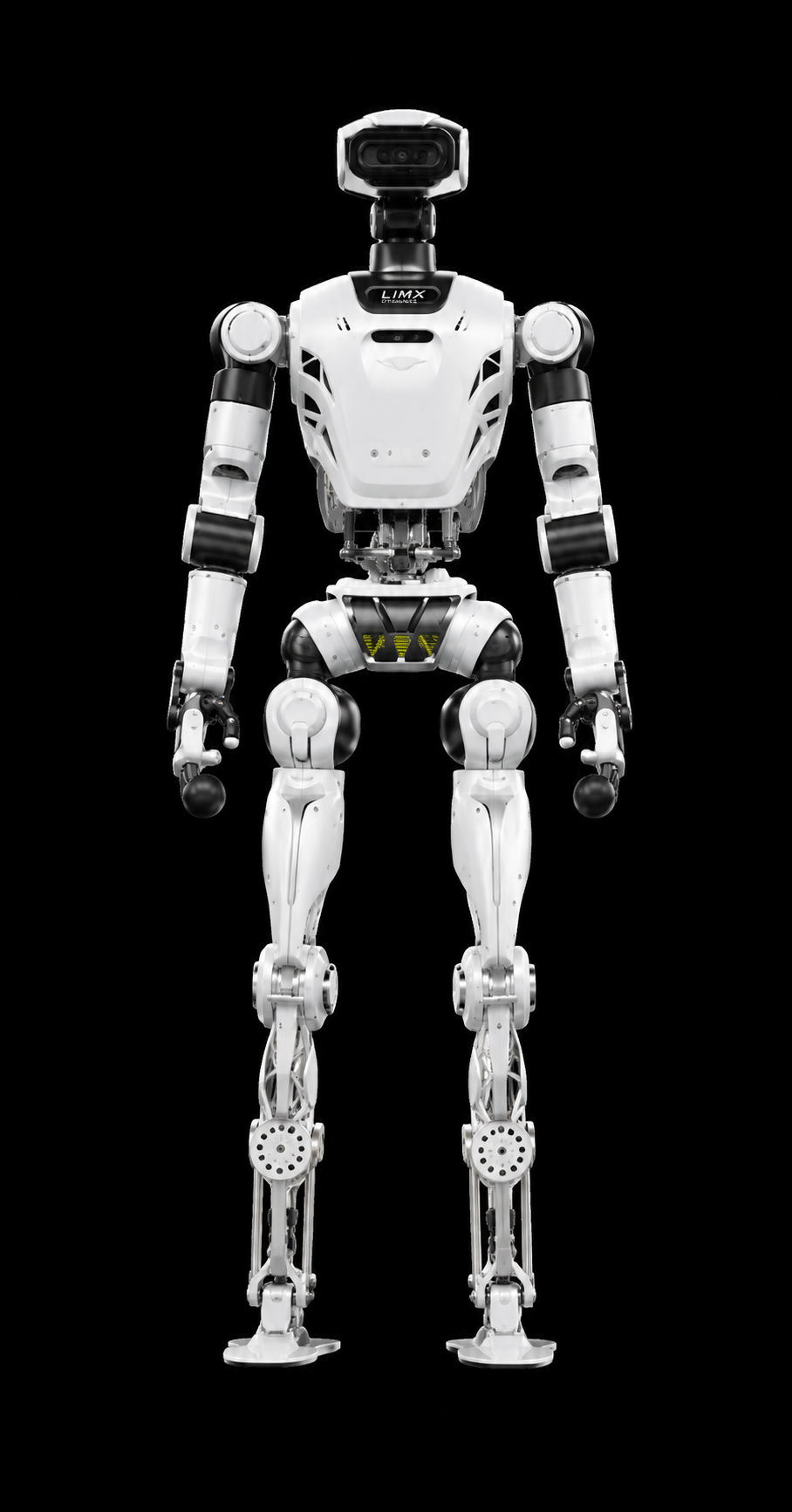
CL-1
CL-1 is a humanoid robot by LimX Dynamics. This robot profile covers robot specs, history, AI technologies, bipedal locomotion, company background, and real-world use cases.
Description
The CL-1 is a humanoid robot from LimX Dynamics capable of climbing stairs in real time through advanced terrain perception. It serves as a research platform for the development of motion control and artificial intelligence algorithms. The CL-1's terrain perception pipeline classifies stair geometry riser height, tread depth, and edge position within 200 ms of visual detection, enabling autonomous stair navigation in previously unseen environments without pre-built maps. LimX Dynamics conducted construction site inspection trials where CL-1 navigated multi-story scaffold structures autonomously, demonstrating practical value in unstructured industrial settings. Its whole-body MPC controller simultaneously optimizes foot placement, center-of-mass trajectory, and joint torques a computationally demanding approach executed in real time on its onboard Jetson Orin.
Taken together, CL-1 reads as a platform built around height of 157 cm, weight of 50 kg, and dof of 20, with Advanced terrain perception, Real-time motion control, and Adaptive locomotion algorithms supporting Robotics research, AI algorithm development, and Navigation on complex terrain. That makes the profile feel more grounded in how LimX Dynamics Shenzhen, China is positioning the robot for real operating environments rather than as a one-off demo.
Specifications
In practical terms, these figures describe a robot optimized for Robotics research, AI algorithm development, and Navigation on complex terrain, while Advanced terrain perception, Real-time motion control, and Adaptive locomotion algorithms define the balance between mobility, perception, and manipulation. The specification set also helps explain the scale of tasks CL-1 can realistically handle today.
History
- 2023: CL-1 launched by LimX Dynamics
- 2024: Real-time stair climbing demonstration
- 2025: Control algorithm improvements
Overall, the timeline shows how CL-1 moved from research or early unveiling toward clearer operational intent, with each stage tightening the link between height of 157 cm, weight of 50 kg, and dof of 20 and the jobs it is expected to perform. It also shows how the project matured from concept validation into a more deployment-oriented platform.
Use Cases
- Robotics research
- AI algorithm development
- Navigation on complex terrain
- Test platform
Across these roles, CL-1 is being framed less as a general-purpose android and more as a system that can repeatedly deliver value in Robotics research, AI algorithm development, and Navigation on complex terrain. Advanced terrain perception, Real-time motion control, and Adaptive locomotion algorithms are the pieces that make those scenarios believable, because they connect sensing, planning, and physical execution into one workflow.
Technical Details
The CL-1 humanoid robot from LimX Dynamics features proprietary high-performing actuators, onboard sensors including cameras, LiDAR, and IMUs for real-time terrain perception, advanced AI algorithms for motion control and generalization, and 20 degrees of freedom, enabling its key capability of dynamic stair climbing and slope navigation in complex environments.Humanoid.guide, YouTube Transcript.
Taken together, this stack suggests a machine whose real advantage comes from how Advanced terrain perception, Real-time motion control, and Adaptive locomotion algorithms are coordinated around height of 157 cm, weight of 50 kg, and dof of 20. The result is a platform that can convert perception into stable motion and task execution with less operator intervention than a simpler scripted robot.
Technologies dream
Universal research platform with human-level embodied AI, one-demonstration skill learning, instant knowledge transfer between robots, algorithmic self-evolution, total situational awareness.
Past
LimX Dynamics developed sim-to-real reinforcement learning for legged robots, achieving zero-shot transfer of stair-climbing policies from simulation.
Present
Real-time stair climbing, adaptive gait planning, sim-to-real RL control, terrain perception, robust bipedal locomotion on challenging surfaces.
Future
Humanoids that navigate any urban environment stairs, curbs, rubble as naturally as humans, without prior mapping.
Technologies
- Advanced terrain perception
- Real-time motion control
- Adaptive locomotion algorithms
- Depth sensors
- Embedded AI
Together, these technologies show that CL-1 depends on a layered architecture rather than one breakthrough component. Advanced terrain perception, Real-time motion control, and Adaptive locomotion algorithms provide the core capabilities, while the surrounding stack determines how well the robot can perceive context, stay stable, and complete tasks without fragile scripting.