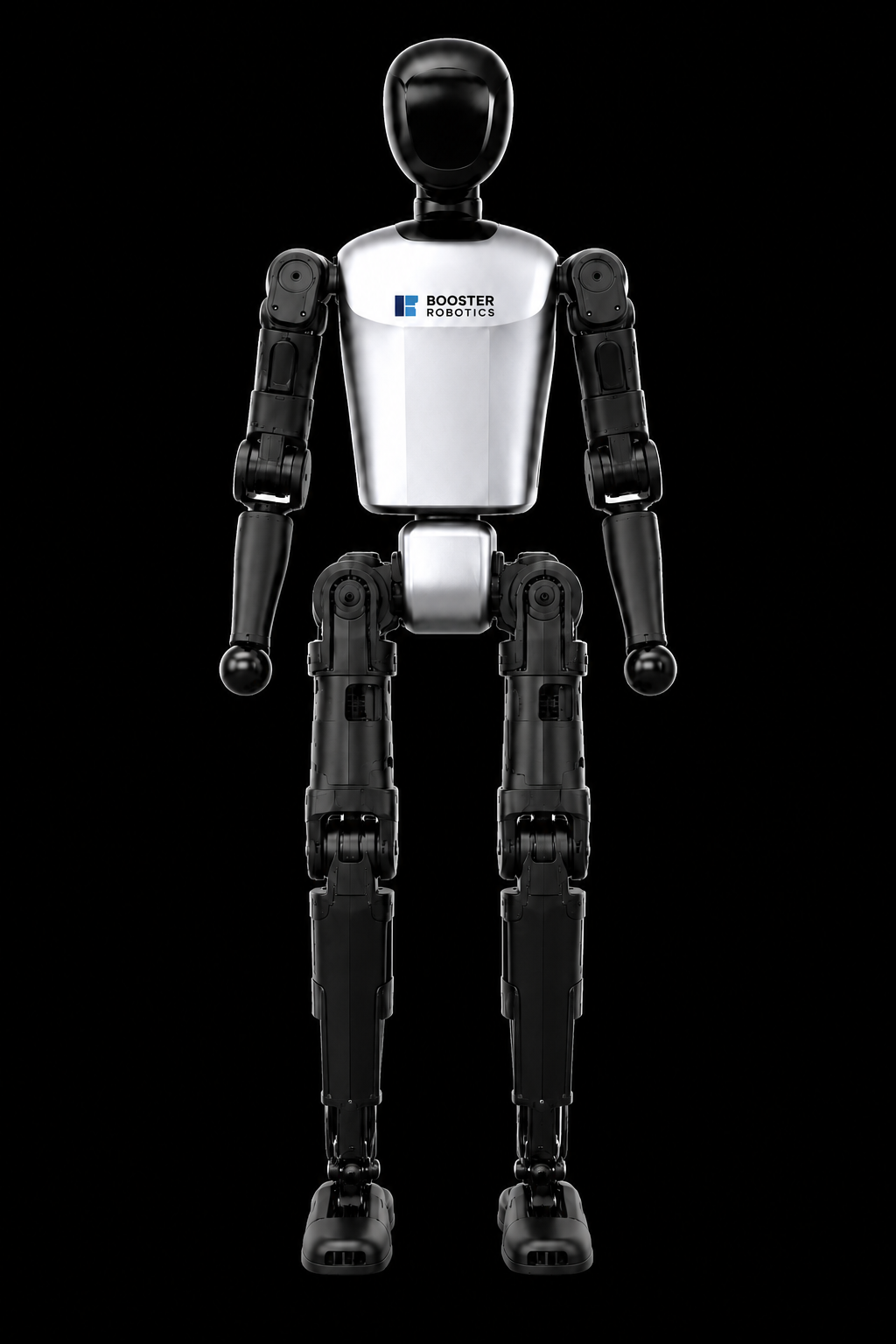
Booster T1
Booster T1 is a humanoid robot by Booster Robotics. This robot profile covers robot specs, history, AI technologies, bipedal locomotion, company background, and real-world use cases.
Description
The Booster T1 is a versatile open-source humanoid robot designed by Chinase company Booster Robotics for researchers and developers. With its 23 degrees of freedom, it is capable of agile movements and was crowned champion of RoboCup 2025 in the AdultSize category. Booster Robotics published the T1's complete SDK, API documentation, and mechanical CAD files as open-source resources on GitHub, establishing one of the most fully open development ecosystems of any commercial humanoid robot. The T1's price point below $20,000 was a deliberate strategic decision to lower the entry barrier for university labs, independent researchers, and developers who previously could not afford full-size bipedal humanoid hardware. Its 23-DoF design and ROS2-compatible architecture allow direct porting of algorithms developed on simulated robots reducing the hardware-to-deployment gap for academic researchers.
Taken together, Booster T1 reads as a platform built around height of 118 cm, weight of ~30 kg, and dof of 23, with Open-source architecture, 23 degrees of freedom, and Agile bipedal locomotion supporting Robotics research, RoboCup competitions, and Algorithm development. That makes the profile feel more grounded in how Booster Robotics China is positioning the robot for real operating environments rather than as a one-off demo.
Specifications
In practical terms, these figures describe a robot optimized for Robotics research, RoboCup competitions, and Algorithm development, while Open-source architecture, 23 degrees of freedom, and Agile bipedal locomotion define the balance between mobility, perception, and manipulation. The specification set also helps explain the scale of tasks Booster T1 can realistically handle today.
History
- 2024: Booster T1 launched as a research platform
- 2025: RoboCup champion in the AdultSize category
- 2025: Commercial availability for developers
Overall, the timeline shows how Booster T1 moved from research or early unveiling toward clearer operational intent, with each stage tightening the link between height of 118 cm, weight of ~30 kg, and dof of 23 and the jobs it is expected to perform. It also shows how the project matured from concept validation into a more deployment-oriented platform.
Use Cases
- Robotics research
- RoboCup competitions
- Algorithm development
- AI education
Across these roles, Booster T1 is being framed less as a general-purpose android and more as a system that can repeatedly deliver value in Robotics research, RoboCup competitions, and Algorithm development. Open-source architecture, 23 degrees of freedom, and Agile bipedal locomotion are the pieces that make those scenarios believable, because they connect sensing, planning, and physical execution into one workflow.
Technologies dream
Brain-machine interface for intuitive control, real-time component self-repair, total situational awareness via neurosensory fusion, universal instant learning, 72-hour energy autonomy, swarm coordination via collective AI.
Past
Booster Robotics made humanoid hardware accessible by open-sourcing designs and leveraging China's low-cost manufacturing ecosystem.
Present
35 DoF, modular architecture, open-source software, ROS 2 support, sim-to-real RL, affordable price for university labs.
Future
A global open-source humanoid ecosystem where researchers worldwide contribute locomotion, manipulation, and AI improvements.
Technologies
- Open-source architecture
- 23 degrees of freedom
- Agile bipedal locomotion
- Developer SDK
- ROS compatible
- Multimodal sensors
Together, these technologies show that Booster T1 depends on a layered architecture rather than one breakthrough component. Open-source architecture, 23 degrees of freedom, and Agile bipedal locomotion provide the core capabilities, while the surrounding stack determines how well the robot can perceive context, stay stable, and complete tasks without fragile scripting.