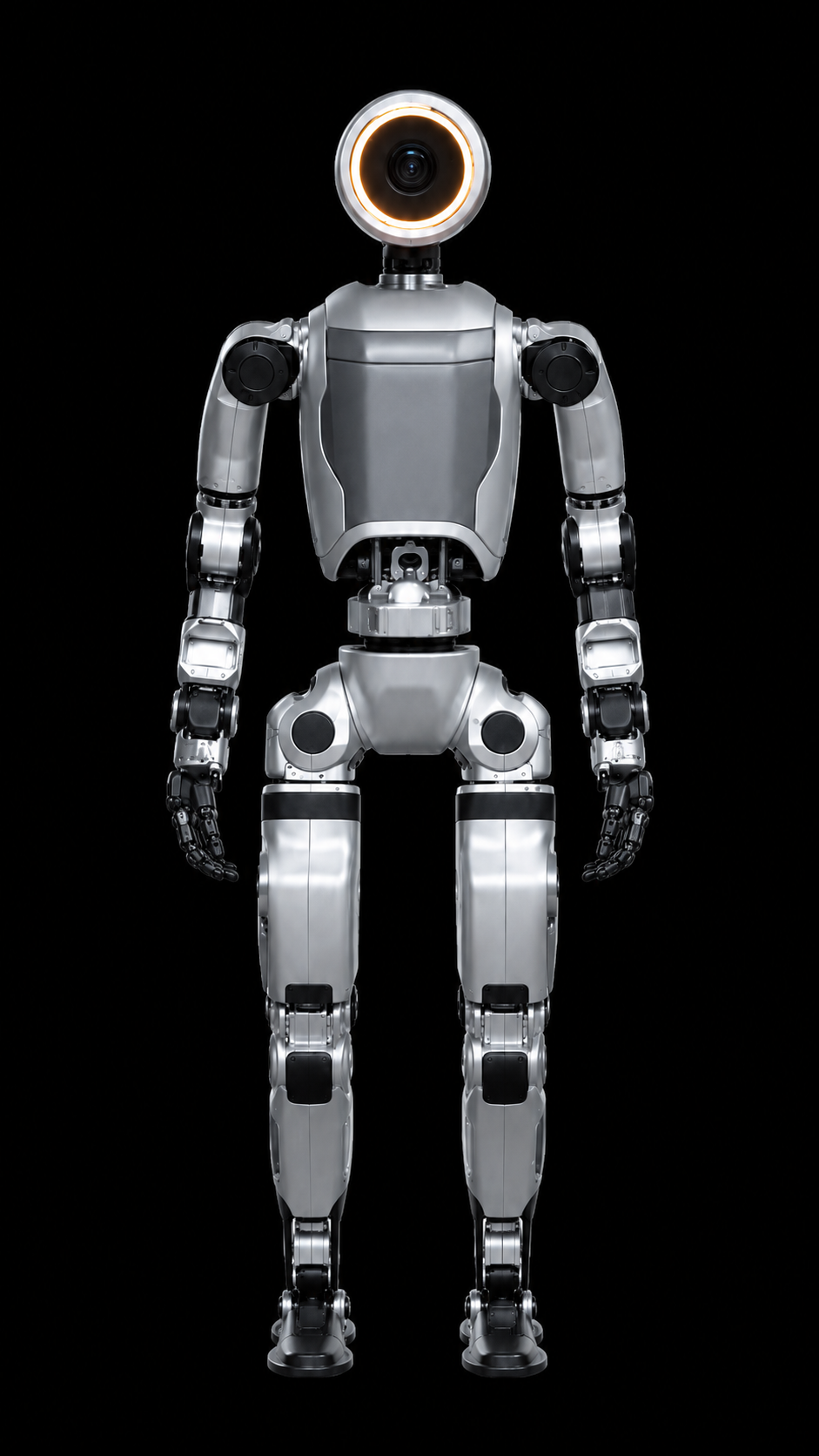
Atlas
Atlas is a humanoid robot by Boston Dynamics. This robot profile covers robot specs, history, AI technologies, bipedal locomotion, company background, and real-world use cases.
Description
Atlas is the world's most dynamic humanoid robot, developed by Boston Dynamics (a Hyundai subsidiary). Originally created with DARPA funding in 2013, Atlas evolved through several generations before its revolutionary transition to a fully electric design in April 2024. The commercial version unveiled at CES 2026 represents the pinnacle of humanoid robotic engineering, standing 1.9 m tall and lifting 50 kg. Boston Dynamics partnered with Google DeepMind to develop Large Behavior Models (LBMs), enabling Atlas to acquire new manipulation tasks directly from video demonstrations without explicit programming. The commercial D1 variant supports hot-swappable battery packs for continuous multi-shift factory operation. At CES 2026, Atlas received the "Best Robot" award and Hyundai confirmed fleet deployment across its global automotive manufacturing network.
Taken together, Atlas reads as a platform built around height of 1,9 m, weight of 90 kg, and dof of 56, with High-torque electric rotary actuators, Reinforcement learning, and 3D LiDAR + stereo cameras supporting Industrial material handling at Hyundai, Warehouse logistics and order picking, and Assembly line support. That makes the profile feel more grounded in how Boston Dynamics Waltham, Massachusetts, USA is positioning the robot for real operating environments rather than as a one-off demo.
Specifications
In practical terms, these figures describe a robot optimized for Industrial material handling at Hyundai, Warehouse logistics and order picking, and Assembly line support, while High-torque electric rotary actuators, Reinforcement learning, and 3D LiDAR + stereo cameras define the balance between mobility, perception, and manipulation. The specification set also helps explain the scale of tasks Atlas can realistically handle today.
History
- 2013: First Atlas prototype unveiled (hydraulic, 1.8 m, 150 kg)
- 2016: Autonomous navigation and fall recovery
- 2018: Parkour and backflips, viral videos worldwide
- 2023: Hydraulic Atlas retired after 10 years
- April 2024: Fully electric Atlas revealed rotary actuators
- January 2026: Commercial Atlas launched at CES, deployed at Hyundai
Overall, the timeline shows how Atlas moved from research or early unveiling toward clearer operational intent, with each stage tightening the link between height of 1,9 m, weight of 90 kg, and dof of 56 and the jobs it is expected to perform. It also shows how the project matured from concept validation into a more deployment-oriented platform.
Use Cases
- Industrial material handling at Hyundai
- Warehouse logistics and order picking
- Assembly line support
- Inspection in hazardous environments
- AI research platform for Google DeepMind
- Disaster response
Across these roles, Atlas is being framed less as a general-purpose android and more as a system that can repeatedly deliver value in Industrial material handling at Hyundai, Warehouse logistics and order picking, and Assembly line support. High-torque electric rotary actuators, Reinforcement learning, and 3D LiDAR + stereo cameras are the pieces that make those scenarios believable, because they connect sensing, planning, and physical execution into one workflow.
Technical Details
The latest Atlas humanoid robot from Boston Dynamics features custom high-powered electric actuators supplied by Hyundai Mobis, tactile sensors in fingers and palm plus 360° camera view, and an AI system integrating Google DeepMind foundation models with Large Behavior Models for autonomous task learning and execution, boasting 56 degrees of freedom including fully rotational joints. Its key capability includes lifting 50 kg instantly or 30 kg sustained, reaching 2.3 m, and performing dynamic whole-body manipulation in industrial environments with minimal supervision.Boston Dynamics spec sheet, Boston Dynamics product page, CES announcement, LBM blog.
Taken together, this stack suggests a machine whose real advantage comes from how High-torque electric rotary actuators, Reinforcement learning, and 3D LiDAR + stereo cameras are coordinated around height of 1,9 m, weight of 90 kg, and dof of 56. The result is a platform that can convert perception into stable motion and task execution with less operator intervention than a simpler scripted robot.
Technologies dream
Full neurosensory fusion for total situational awareness, real-time self-repair of mechanical components, swarm coordination of Atlas units via collective AI, brain-machine interface for immersive human control, dynamic morphological adaptation per task.
Past
Hydraulic Atlas (2013–2023) required external power, used DARPA-funded hydraulic actuators, and relied on LiDAR-based SLAM for navigation in disaster scenarios.
Present
Fully electric actuators by Hyundai Mobis, 360° stereo vision, tactile finger/palm sensors, fast battery-swap system, real-time whole-body MPC control.
Future
Autonomous multi-robot factory coordination, AI-driven task planning without human programming, self-diagnosing hardware with predictive maintenance.
Technologies
- High-torque electric rotary actuators
- Reinforcement learning (Google DeepMind)
- 3D LiDAR + stereo cameras
- Real-time motion planning
- Dexterous hands with 16 DoF
- Autonomous SLAM navigation
- Cloud AI for task learning
- Fall recovery
Together, these technologies show that Atlas depends on a layered architecture rather than one breakthrough component. High-torque electric rotary actuators, Reinforcement learning, and 3D LiDAR + stereo cameras provide the core capabilities, while the surrounding stack determines how well the robot can perceive context, stay stable, and complete tasks without fragile scripting.