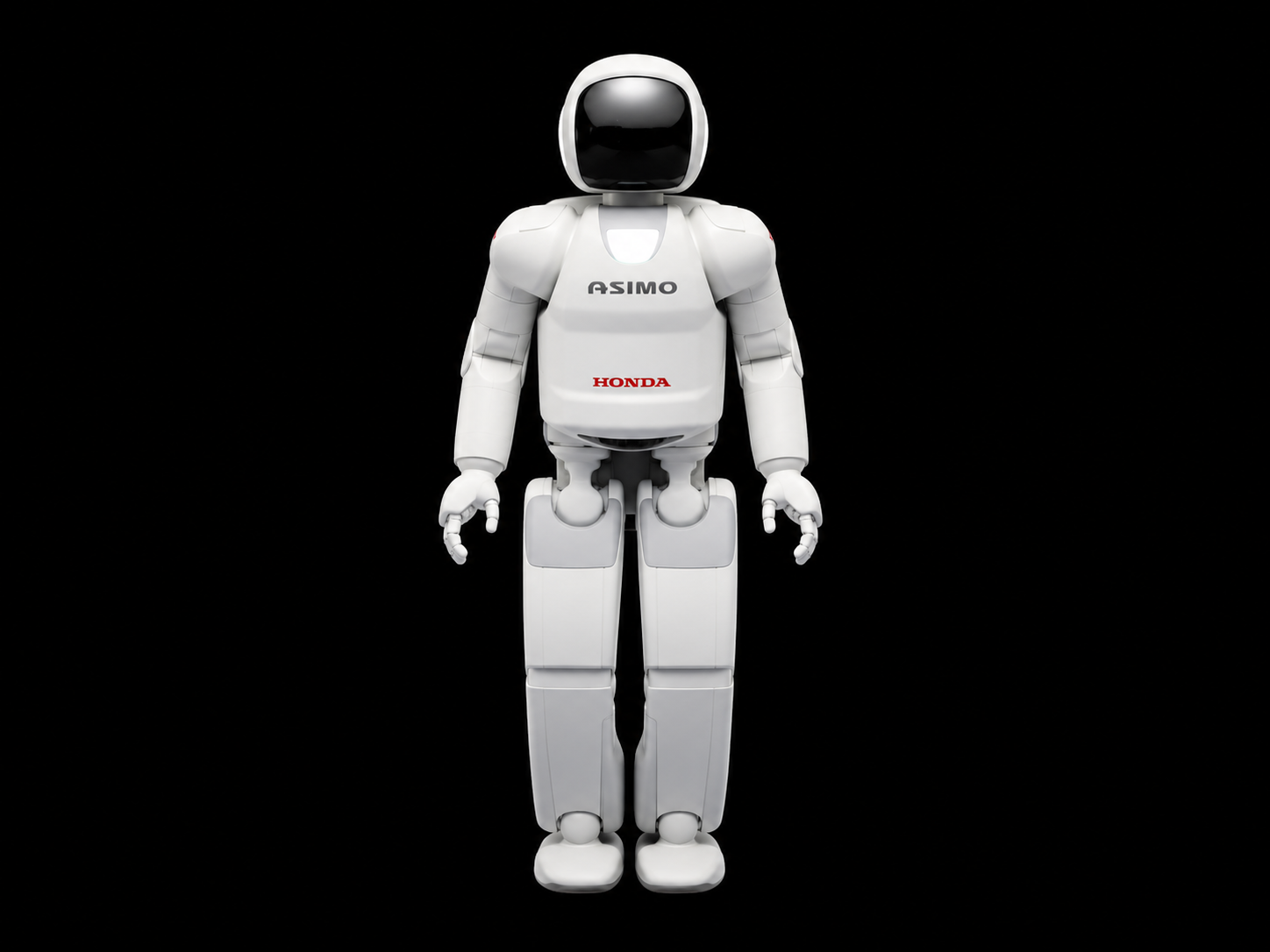
ASIMO
ASIMO is a humanoid robot by Honda. This robot profile covers robot specs, history, AI technologies, bipedal locomotion, company background, and real-world use cases.
Description
ASIMO (Advanced Step in Innovative Mobility) is the legendary pioneer of humanoid robotics, developed by Honda. Standing 130 cm and weighing 54 kg with 57 DoF, ASIMO could run, dance, serve drinks, and recognize faces and gestures. After 22 years of innovation, Honda retired ASIMO in 2022, but its technologies continue to influence all modern humanoid robotics. At launch ASIMO held the Guinness World Record for the most degrees of freedom in a humanoid robot (57 DoF) and was the first bipedal humanoid. Honda invested an estimated ¥300 billion in ASIMO over its 18-year development span, making it one of the most expensive robotics R&D programs in history. Honda officially retired ASIMO in 2018, channeling accumulated research into the Honda Avatar Robot and AI-driven mobility systems for automobiles and assistive devices.
Taken together, ASIMO reads as a platform built around height of 130 cm, weight of 54 kg, and dof of 57, with Predictive bipedal locomotion control, Facial and vocal recognition, and Human gesture detection and tracking supporting Technology demonstration and events, Fundamental research in bipedal locomotion, and Personal assistance. That makes the profile feel more grounded in how Honda Tokyo, Japan is positioning the robot for real operating environments rather than as a one-off demo.
Specifications
In practical terms, these figures describe a robot optimized for Technology demonstration and events, Fundamental research in bipedal locomotion, and Personal assistance, while Predictive bipedal locomotion control, Facial and vocal recognition, and Human gesture detection and tracking define the balance between mobility, perception, and manipulation. The specification set also helps explain the scale of tasks ASIMO can realistically handle today.
History
- 1986: Honda begins research in bipedal locomotion
- 2000: ASIMO unveiled first commercial bipedal humanoid
- 2005: ASIMO runs
- 2011: ASIMO upgraded 57 DoF, advanced recognition
- 2014: ASIMO reaches
- March 2022: ASIMO retired after 22 years of innovation
Overall, the timeline shows how ASIMO moved from research or early unveiling toward clearer operational intent, with each stage tightening the link between height of 130 cm, weight of 54 kg, and dof of 57 and the jobs it is expected to perform. It also shows how the project matured from concept validation into a more deployment-oriented platform.
Use Cases
- Technology demonstration and events
- Fundamental research in bipedal locomotion
- Personal assistance (concept)
- Welcome guide in Honda facilities
- Inspiration for world robotics
- Education and scientific awareness
Across these roles, ASIMO is being framed less as a general-purpose android and more as a system that can repeatedly deliver value in Technology demonstration and events, Fundamental research in bipedal locomotion, and Personal assistance. Predictive bipedal locomotion control, Facial and vocal recognition, and Human gesture detection and tracking are the pieces that make those scenarios believable, because they connect sensing, planning, and physical execution into one workflow.
Technical Details
Honda's ASIMO humanoid robot features 57 degrees of freedom (head: 3, arms: 7×2, hands: 13×2, torso: 2, legs: 6×2), electric actuators, and sensors including visual, auditory, spatial, tactile (palms), and force (fingers) sensors.Honda Global. Its AI system integrates multi-sensor inputs to recognize environment, predict human movements, and generate autonomous behaviors, enabling key capabilities like and real-time posture balancing.Honda Global
Taken together, this stack suggests a machine whose real advantage comes from how Predictive bipedal locomotion control, Facial and vocal recognition, and Human gesture detection and tracking are coordinated around height of 130 cm, weight of 54 kg, and dof of 57. The result is a platform that can convert perception into stable motion and task execution with less operator intervention than a simpler scripted robot.
Technologies dream
Digital resurrection ASIMO reborn as an immortal cloud AI, transferring its 22 years of learning to next-generation robots, becoming the collective consciousness of all Honda robotics.
Past
Honda's P-series prototypes (P1-P3, 1993-2000) pioneered bipedal walking. ASIMO (2000) was the culmination of 14 years of walking research.
Present
Retired in 2022 after 22 years. Legacy: 57 DoF, running, dancing, serving drinks, stair climbing, face/gesture recognition defined modern humanoid robotics.
Future
Honda Avatar Robot continues ASIMO's legacy. ASIMO's technologies live on in Honda's walking assist devices and next-gen telepresence systems.
Technologies
- Predictive bipedal locomotion control
- Facial and vocal recognition
- Human gesture detection and tracking
- Real-time trajectory planning
- Advanced dynamic stabilization
- Multi-finger dexterous manipulation
- Multilingual communication
- Integrated force and torque sensors
Together, these technologies show that ASIMO depends on a layered architecture rather than one breakthrough component. Predictive bipedal locomotion control, Facial and vocal recognition, and Human gesture detection and tracking provide the core capabilities, while the surrounding stack determines how well the robot can perceive context, stay stable, and complete tasks without fragile scripting.