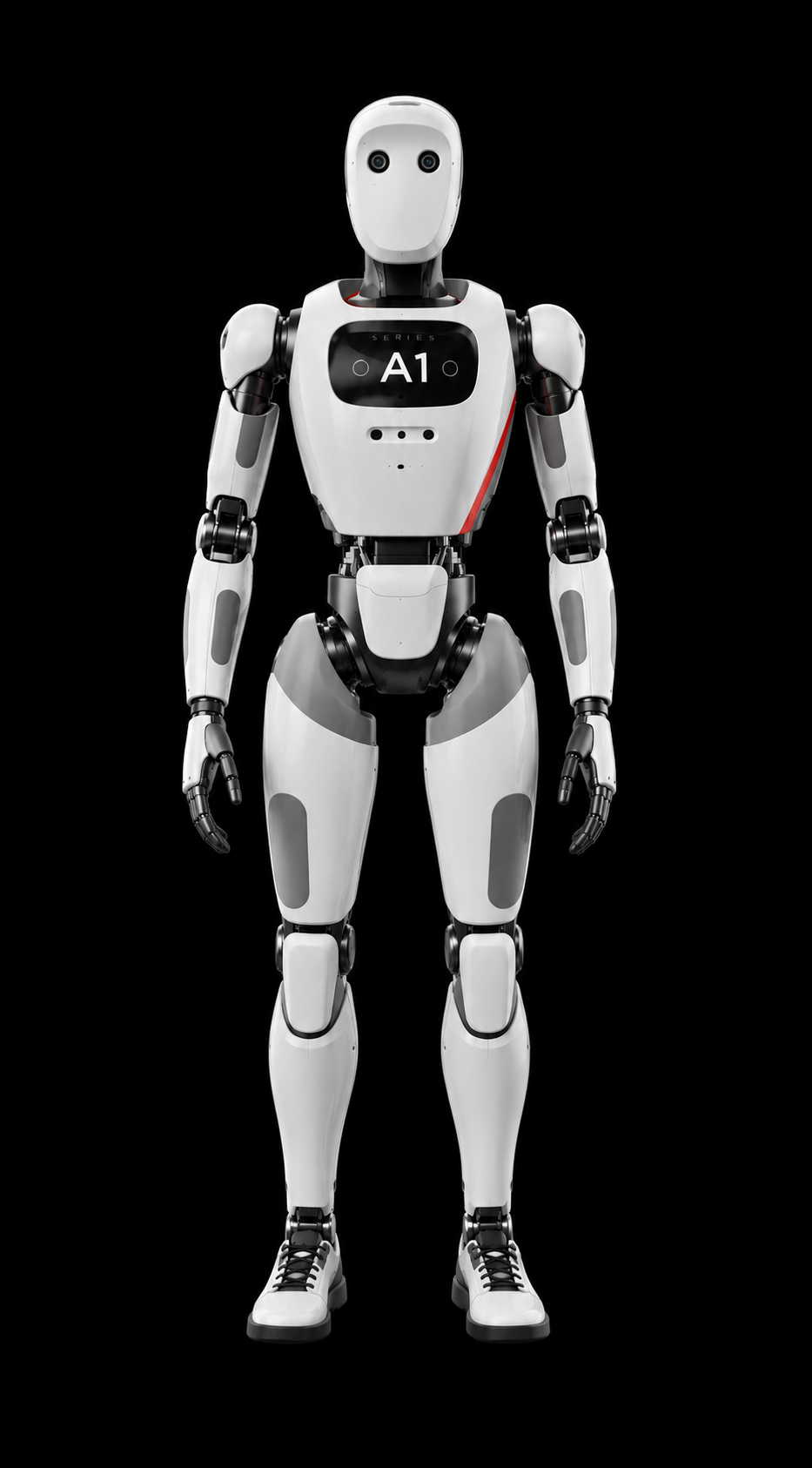
Apollo
Apollo is a humanoid robot by Apptronik. This robot profile covers robot specs, history, AI technologies, bipedal locomotion, company background, and real-world use cases.
Description
Apollo is Apptronik's versatile humanoid robot, designed to revolutionize work in warehouses and factories. Standing 172 cm and weighing 73 kg, Apollo can lift up to 25 kg and runs for up to 4 hours on a swappable battery. Born from research at the University of Texas at Austin, Apptronik collaborates with giants like Mercedes-Benz and GXO Logistics. Apptronik signed commercial pilot agreements with Mercedes-Benz and GXO Logistics, targeting multi-shift autonomous deployment in automotive manufacturing and large-scale warehouse fulfillment. The series-elastic linear actuators (SEA) across all 30 degrees of freedom provide inherent compliance and accurate force control, enabling safe physical collaboration with human workers without dedicated safety cages. The design builds directly on a decade of NASA-funded research at the University of Texas at Austin, including lessons from the Valkyrie program, giving Apollo one of the most mature actuator safety records in the industry.
Taken together, Apollo reads as a platform built around height of 172 cm, weight of 73 kg, and dof of 35+, with Proprietary electric actuators, Hot-swappable battery, and Visual perception + LiDAR supporting Logistics at Mercedes-Benz, GXO Logistics operations, and Warehouse material handling. That makes the profile feel more grounded in how Apptronik Austin, Texas, USA is positioning the robot for real operating environments rather than as a one-off demo.
Specifications
In practical terms, these figures describe a robot optimized for Logistics at Mercedes-Benz, GXO Logistics operations, and Warehouse material handling, while Proprietary electric actuators, Hot-swappable battery, and Visual perception + LiDAR define the balance between mobility, perception, and manipulation. The specification set also helps explain the scale of tasks Apollo can realistically handle today.
History
- 2016: Apptronik founded, born from UT Austin
- 2023: Apollo prototype unveiled to the public
- 2024: Partnership with Mercedes-Benz and GXO
- 2024: Collaboration with Jabil for large-scale production
- 2025: Apollo 2.0 with improvements
- 2026: Commercial deployments expanding
Overall, the timeline shows how Apollo moved from research or early unveiling toward clearer operational intent, with each stage tightening the link between height of 172 cm, weight of 73 kg, and dof of 35+ and the jobs it is expected to perform. It also shows how the project matured from concept validation into a more deployment-oriented platform.
Use Cases
- Logistics at Mercedes-Benz
- GXO Logistics operations
- Warehouse material handling
- Assembly line support
- Palletizing and depalletizing
- Material transport
Across these roles, Apollo is being framed less as a general-purpose android and more as a system that can repeatedly deliver value in Logistics at Mercedes-Benz, GXO Logistics operations, and Warehouse material handling. Proprietary electric actuators, Hot-swappable battery, and Visual perception + LiDAR are the pieces that make those scenarios believable, because they connect sensing, planning, and physical execution into one workflow.
Technical Details
Apptronik's Apollo humanoid robot employs custom linear actuators, including series-elastic types for compliant force control in ~30 degrees of freedom across its human-sized frame.Apptronik, The Robot Report. Equipped with NVIDIA Jetson AGX Orin and Orin NX compute for AI processing, perception sensors including stereoscopic cameras, torso 360-degree mapping sensors, and force-torque sensing, it lifts 55 lb payloads as a key capability for warehouse tasks.NVIDIA collaboration, Humanoids Wiki.
Taken together, this stack suggests a machine whose real advantage comes from how Proprietary electric actuators, Hot-swappable battery, and Visual perception + LiDAR are coordinated around height of 172 cm, weight of 73 kg, and dof of 35+. The result is a platform that can convert perception into stable motion and task execution with less operator intervention than a simpler scripted robot.
Technologies dream
Solid-state battery with 48-hour autonomy, surgical-level manipulation with nanometric haptic feedback, telepathic communication with human operator via neural interface, morphological finger adaptation per object grasped.
Past
Apptronik spent 10 years at UT Austin developing series elastic actuators and compliant control for safe human interaction, culminating in the Valkyrie collaboration with NASA.
Present
Custom linear SEA actuators across 30 DoF, NVIDIA Jetson AGX Orin, swappable batteries, 25 kg payload, collaborative safety through force-limited joints.
Future
Fleet deployment across Mercedes-Benz and GXO warehouses, learned task generalization from few demonstrations, multi-shift autonomous operation.
Technologies
- Proprietary electric actuators
- Hot-swappable battery
- Visual perception + LiDAR
- Real-time motion planning
- Open SDK for integrators
- Manipulation of varied objects
- Autonomous navigation in warehouses
- Modular architecture
Together, these technologies show that Apollo depends on a layered architecture rather than one breakthrough component. Proprietary electric actuators, Hot-swappable battery, and Visual perception + LiDAR provide the core capabilities, while the surrounding stack determines how well the robot can perceive context, stay stable, and complete tasks without fragile scripting.