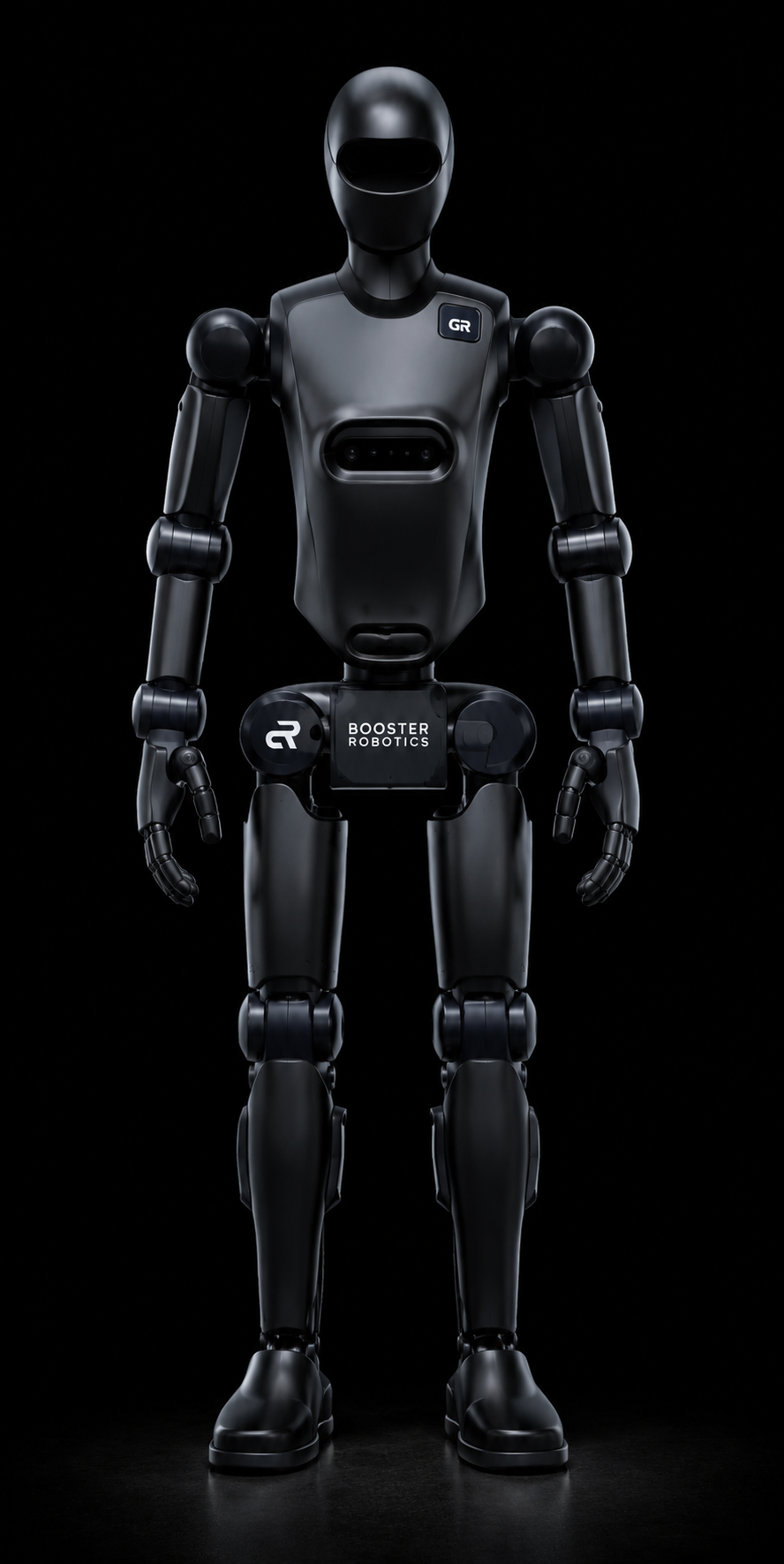
Agile ONE
Agile ONE is a humanoid robot by Agile Robots. This robot profile covers robot specs, history, AI technologies, bipedal locomotion, company background, and real-world use cases.
Description
The Agile ONE is an industrial humanoid robot with extremely dexterous hands and advanced artificial intelligence for human-robot collaboration. It is designed to perform complex tasks such as precision assembly and machine maintenance in production environments. Agile ONE's hands feature 23 DoF each and integrated tactile arrays that can discriminate surface textures and detect micro-slippage at the fingertip enabling in-hand reorientation of objects that purely vision-guided grippers cannot perform reliably. Agile Robots AG operates manufacturing and R&D facilities in both Germany and China, backed by Tencent, and has positioned Agile ONE as a bridge between European precision engineering standards and Chinese manufacturing scale. The platform's whole-body controller employs a hierarchical optimization framework that simultaneously satisfies locomotion stability, manipulation force, and joint-limit constraints enabled by its dual NVIDIA Orin SoC configuration.
Taken together, Agile ONE reads as a platform built around height of 174 cm, weight of 69 kg, and hands of 21 joints per hand, with Ultra-dexterous hands with 21 joints, Advanced AI for collaboration, and Precise force control supporting Precision assembly, Machine maintenance, and Human-robot collaboration. That makes the profile feel more grounded in how Agile Robots SE Munich, Germany is positioning the robot for real operating environments rather than as a one-off demo.
Specifications
In practical terms, these figures describe a robot optimized for Precision assembly, Machine maintenance, and Human-robot collaboration, while Ultra-dexterous hands with 21 joints, Advanced AI for collaboration, and Precise force control define the balance between mobility, perception, and manipulation. The specification set also helps explain the scale of tasks Agile ONE can realistically handle today.
History
- 2025: Agile ONE presented
- 2026: Production begins
- 2026: Deployment in the manufacturing industry
Overall, the timeline shows how Agile ONE moved from research or early unveiling toward clearer operational intent, with each stage tightening the link between height of 174 cm, weight of 69 kg, and hands of 21 joints per hand and the jobs it is expected to perform. It also shows how the project matured from concept validation into a more deployment-oriented platform.
Use Cases
- Precision assembly
- Machine maintenance
- Human-robot collaboration
- Industrial production
Across these roles, Agile ONE is being framed less as a general-purpose android and more as a system that can repeatedly deliver value in Precision assembly, Machine maintenance, and Human-robot collaboration. Ultra-dexterous hands with 21 joints, Advanced AI for collaboration, and Precise force control are the pieces that make those scenarios believable, because they connect sensing, planning, and physical execution into one workflow.
Technical Details
The Agile ONE humanoid robot from Agile Robots features electric actuators with series elastic elements in its dexterous hands, equipped with force-torque sensors, tactile fingertip sensors, intelligent cameras, LiDARs, proximity sensors, and speech recognition.Agile Robots,YouTube It utilizes a layered Robotic Foundation Model AI trained on industrial data for autonomous decision-making, offers 71 degrees of freedom (21 per hand), and excels in precise manipulation of small objects like screws with a 20 kg payload capacity.Humanoid.guide,The Humanoid Hub
Taken together, this stack suggests a machine whose real advantage comes from how Ultra-dexterous hands with 21 joints, Advanced AI for collaboration, and Precise force control are coordinated around height of 174 cm, weight of 69 kg, and hands of 21 joints per hand. The result is a platform that can convert perception into stable motion and task execution with less operator intervention than a simpler scripted robot.
Technologies dream
Autonomous fleet of thousands coordinated by collective AI, universal manipulation of any object, 48-hour solid-state battery autonomy, self-diagnosis and predictive maintenance, instant adaptability to any industrial environment.
Past
Agile Robots was founded by DLR researchers who spent decades developing torque-controlled manipulation and series elastic actuation for space and surgery robots.
Present
Series elastic actuators, force-torque + tactile fingertip sensors, LiDAR, intelligent cameras, layered AI for adaptive human-robot collaboration.
Future
Autonomous precision surgery assistance, micro-assembly in semiconductor manufacturing, AI-guided maintenance of complex industrial machinery.
Technologies
- Ultra-dexterous hands with 21 joints
- Advanced AI for collaboration
- Precise force control
- Vision 3D
- Learning by demonstration
- Integrated collaborative safety
Together, these technologies show that Agile ONE depends on a layered architecture rather than one breakthrough component. Ultra-dexterous hands with 21 joints, Advanced AI for collaboration, and Precise force control provide the core capabilities, while the surrounding stack determines how well the robot can perceive context, stay stable, and complete tasks without fragile scripting.