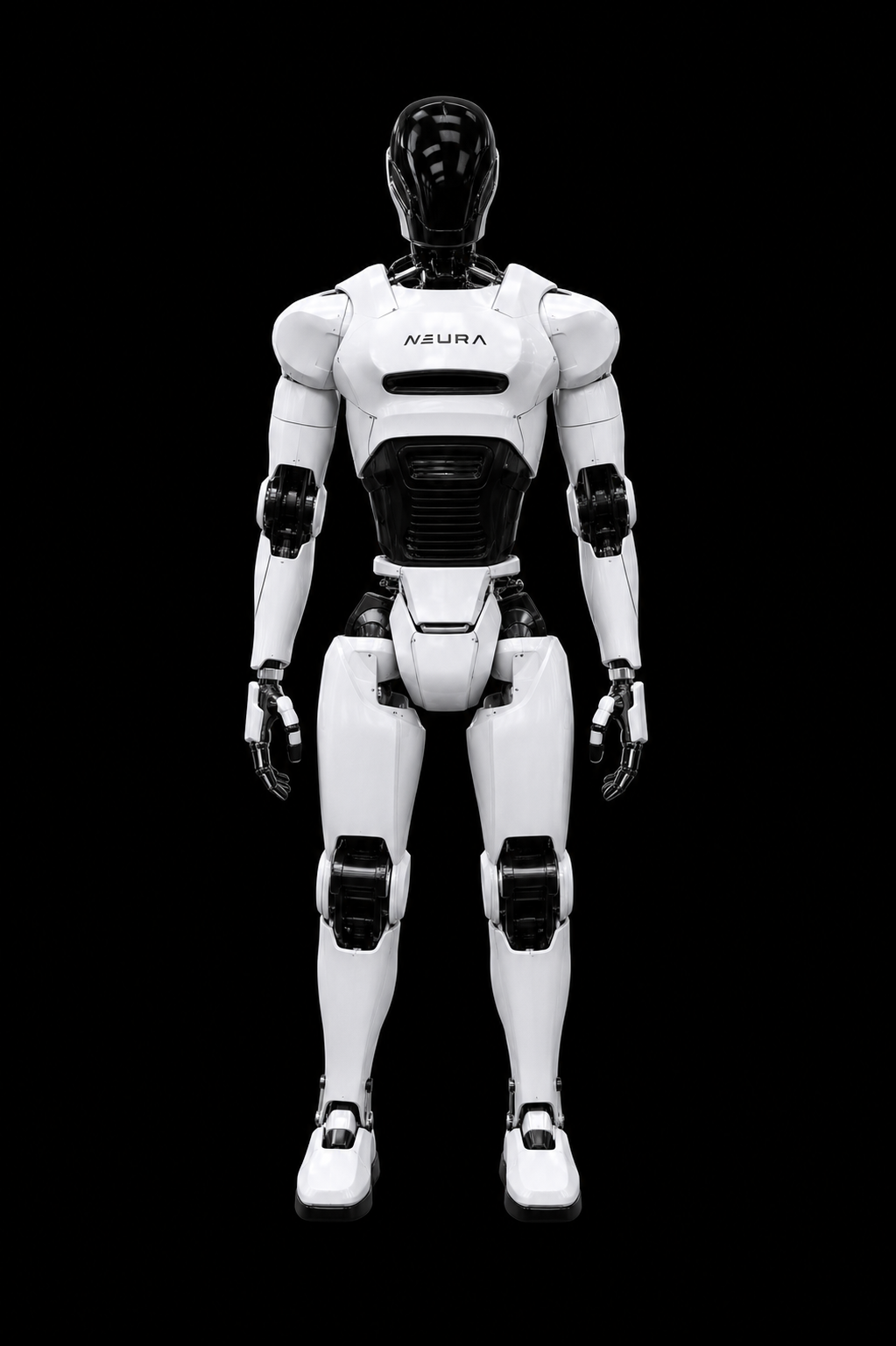
4NE-1
4NE-1 is a humanoid robot by NEURA Robotics. This robot profile covers robot specs, history, AI technologies, bipedal locomotion, company background, and real-world use cases.
Description
The 4NE1 is a cognitive humanoid robot designed in Germany to assist humans in industrial and domestic environments. Thanks to its advanced artificial intelligence and sensory skin, it can interact safely and autonomously in the real world. The 4NE-1's whole-body tactile skin integrates hundreds of distributed capacitive pressure sensors covering its torso, arms, and limbs, enabling contact detection and compliant response anywhere on the body surface a safety architecture central to its eldercare and healthcare use cases. NEURA Robotics raised over €120 million in funding including strategic investment from Körber AG and German industrial partners, among the largest European robotics fundraises at that time. Its AI pipeline processes multimodal inputs visual, auditory, and tactile through a unified neural architecture, enabling context-aware responses that adapt to the emotional state of the interaction partner.
Taken together, 4NE1 reads as a platform built around height of 180 cm, weight of 80 kg, and dof of 55, with Sensory skin for safe interaction, Advanced cognitive AI, and 55 degrees of freedom supporting Industrial assistance, Household tasks, and Safe human-robot interaction. That makes the profile feel more grounded in how NEURA Robotics Metzingen, Germany is positioning the robot for real operating environments rather than as a one-off demo.
Specifications
In practical terms, these figures describe a robot optimized for Industrial assistance, Household tasks, and Safe human-robot interaction, while Sensory skin for safe interaction, Advanced cognitive AI, and 55 degrees of freedom define the balance between mobility, perception, and manipulation. The specification set also helps explain the scale of tasks 4NE1 can realistically handle today.
History
- 2022: 4NE-1 unveiled by NEURA Robotics
- 2024: Generation 3.5 with major improvements
- 2025: Demonstrations in industrial environments
Overall, the timeline shows how 4NE1 moved from research or early unveiling toward clearer operational intent, with each stage tightening the link between height of 180 cm, weight of 80 kg, and dof of 55 and the jobs it is expected to perform. It also shows how the project matured from concept validation into a more deployment-oriented platform.
Use Cases
- Industrial assistance
- Household tasks
- Safe human-robot interaction
- Object manipulation
Across these roles, 4NE1 is being framed less as a general-purpose android and more as a system that can repeatedly deliver value in Industrial assistance, Household tasks, and Safe human-robot interaction. Sensory skin for safe interaction, Advanced cognitive AI, and 55 degrees of freedom are the pieces that make those scenarios believable, because they connect sensing, planning, and physical execution into one workflow.
Technical Details
The 4NE1 humanoid robot from NEURA Robotics utilizes high-torque electric actuators and features 55 degrees of freedom for human-like motion, paired with sensors including 360° perception, full-body tactile sensor skin, 7 cameras, and LiDAR for comprehensive environmental awareness. Its multimodal AI system, incorporating language models, computer vision, and reinforcement learning via the Neuraverse platform, enables key capabilities such as safe human collaboration, 10-100 kg payload handling in unstructured environments Neura Robotics, humanoid.press, Forbes.
Taken together, this stack suggests a machine whose real advantage comes from how Sensory skin for safe interaction, Advanced cognitive AI, and 55 degrees of freedom are coordinated around height of 180 cm, weight of 80 kg, and dof of 55. The result is a platform that can convert perception into stable motion and task execution with less operator intervention than a simpler scripted robot.
Technologies dream
Autonomous fleet of thousands coordinated by collective AI, universal manipulation of any object, 48-hour solid-state battery autonomy, self-diagnosis and predictive maintenance, instant adaptability to any industrial environment.
Past
NEURA Robotics developed cognitive sensor fusion technology combining proximity, tactile, and visual perception for safe human-robot coexistence.
Present
Multi-modal perception (vision, speech, proximity), cognitive AI for autonomous task adaptation, safe human interaction, industrial + domestic applications.
Future
True cognitive household robots that anticipate needs, learn family routines, and manage smart home ecosystems autonomously.
Technologies
- Sensory skin for safe interaction
- Advanced cognitive AI
- 55 degrees of freedom
- Multimodal perception
- Autonomous navigation
- Learning by demonstration
Together, these technologies show that 4NE1 depends on a layered architecture rather than one breakthrough component. Sensory skin for safe interaction, Advanced cognitive AI, and 55 degrees of freedom provide the core capabilities, while the surrounding stack determines how well the robot can perceive context, stay stable, and complete tasks without fragile scripting.